
Perplexity is not a search engine you rank on. It is an answer engine that cites you. Every answer it produces comes with three to eight clickable source links, and those links carry people who are mid-decision, not casually browsing. SeoProfy’s 2026 Perplexity statistics report puts the platform at more than 30 million searches per day, and its users skew toward researchers, founders, analysts, and marketers. That is a reader worth showing up in front of.
The good news: the rules for earning those citations are more knowable than most people assume. This guide walks through the 12 tactics that actually move Perplexity visibility, with the steps to apply each one on your own site.
Who this guide is for
This is written for site owners, marketers, and content teams who already publish decent content but never see it cited in AI answers. You do not need a developer for most of it. If you can edit your robots.txt, restructure a page, and read your analytics, you can act on at least ten of the twelve tactics this week.
The mechanics
How Perplexity picks its sources
Perplexity runs on retrieval-augmented generation, or RAG. For every question a user asks, it searches the live web plus its own index, pulls a shortlist of candidate pages, reranks them with a model trained to judge trust and directness, and then writes one answer that cites the strongest few sources. Nothing is cached from months ago. Your page gets re-evaluated every single time a relevant question comes in.
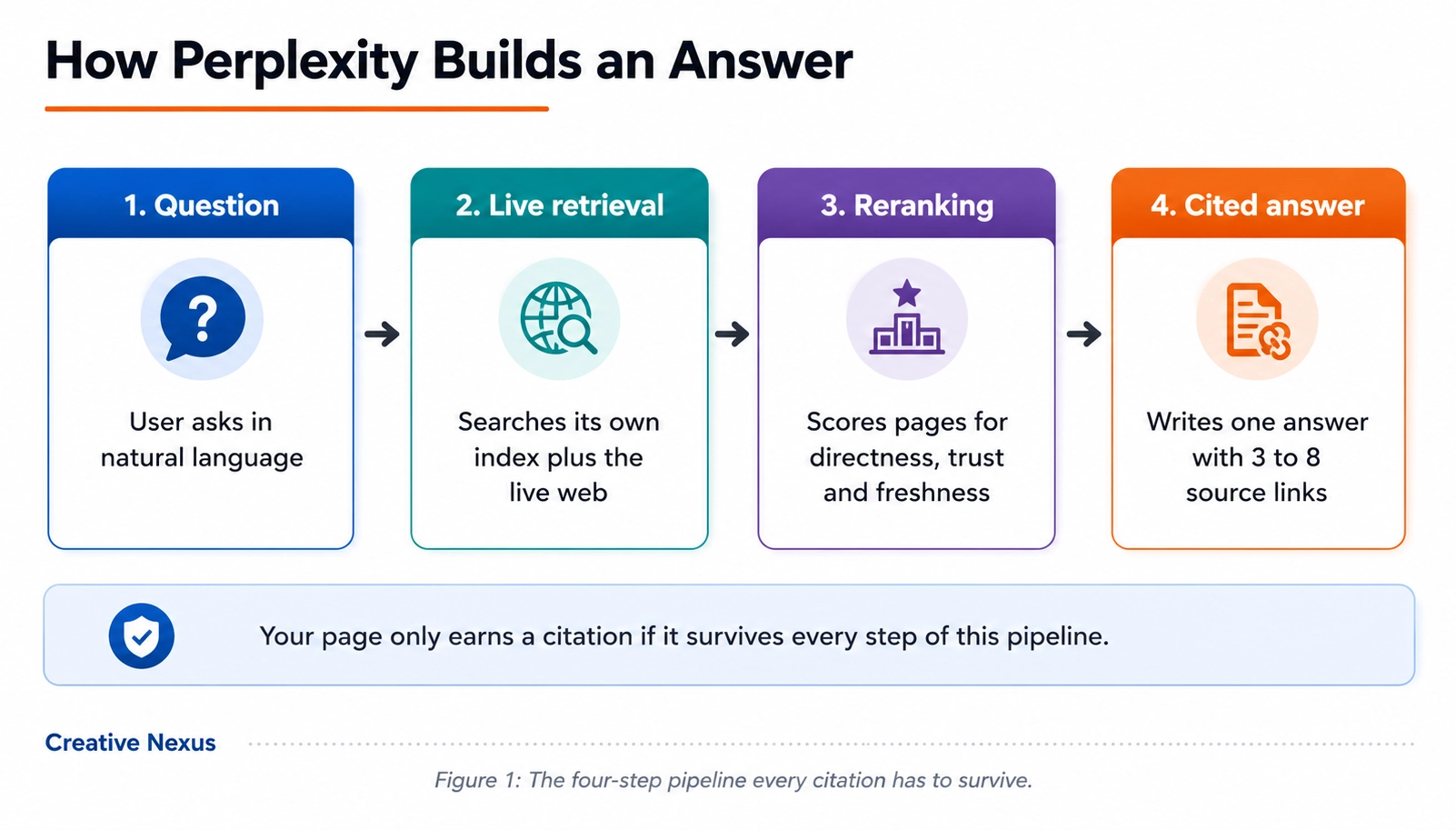
This is where Perplexity parts ways with Google. Google ranks pages for humans who will click and read, so it rewards click-through signals and time on page. Perplexity cites pages for a model that has to lift a clean, defensible answer, so it rewards directness, structure, and proof. A page written to hold a reader for eight minutes can be exactly the wrong page for a model that needs the answer in the first hundred words.
The 12 Tactics, Grouped into four pillars
The 12 tactics below group into four pillars: access, structure, authority, and maintenance. Miss any one pillar, and the other three underperform.
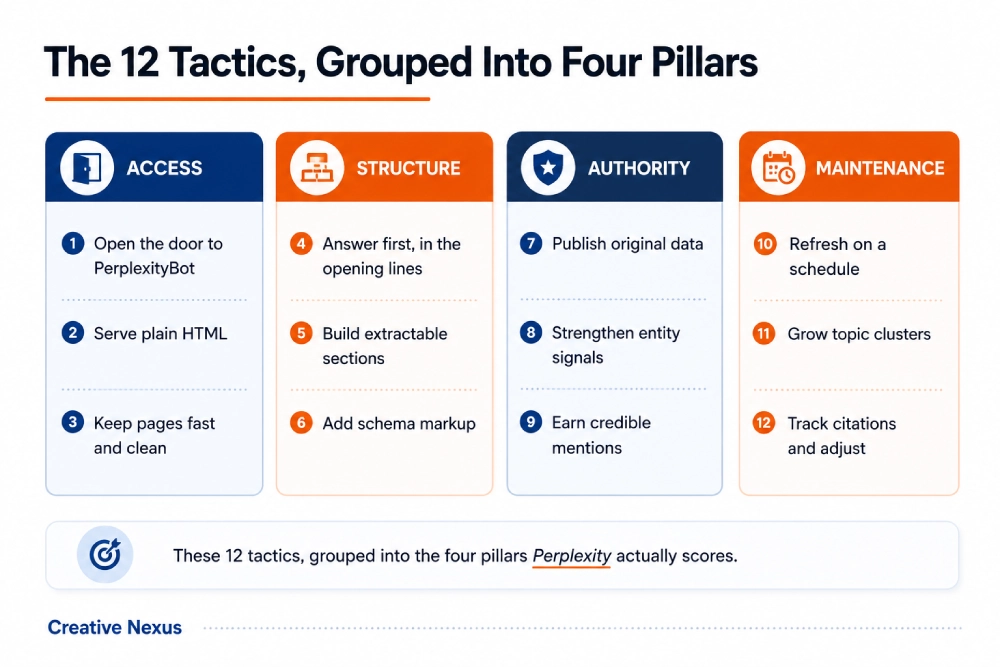
Figure 2: The 12 tactics, grouped into the four pillars,s Perplexity actually scores.
Pillar 1 / Access
Tactic 1: Open the door to PerplexityBot
None of the other eleven tactics matter if Perplexity cannot read your site. Its crawler identifies itself as PerplexityBot, and a second agent called Perplexity-User fetches pages on demand when a user’s question triggers live retrieval.
Check three places where blocks hide:
- Your robots.txt file. Open yourdomain.com/robots.txt and confirm there is no Disallow rule aimed at PerplexityBot or a blanket rule catching all bots.
- Your CDN or firewall. Cloudflare and similar services ship with AI-bot blocking that some plans switch on by default. Whitelist PerplexityBot there, not just in robots.txt.
- Your server logs. If PerplexityBot never appears in them, something upstream is turning it away before robots.txt is even read.
If you want to stay out of AI training data but still appear in AI answers, that is possible: keep PerplexityBot allowed and block only the training-focused crawlers such as GPTBot and Google-Extended. We cover the full crawler decision in our technical SEO guide.
Tactic 2: Serve your answers as plain HTML
PerplexityBot reads server-rendered HTML far more reliably than content assembled by JavaScript in the browser. If your main copy only exists after a React or Vue app finishes loading, the bot may see an empty shell where your answer should be.
Quick test: right-click any money page, choose View Page Source, and search for a sentence from your opening paragraph. If it is not in the raw source, it is not reliably visible to Perplexity. The fix is server-side rendering or static generation for your content pages. Interactive widgets can stay client-side; the words cannot.
Tactic 3: Keep pages fast, clean, and readable
Perplexity’s reranker downgrades pages that are slow to fetch or hard to parse. Three habits cover most of it:
- Keep server response time under 200ms and put a CDN in front of the site if your audience is spread across regions.
- Strip pop-ups, interstitials, and heavy ad units from the pages you want cited. A page where the answer is buried under three overlays reads as low quality to the model.
- Use one H1, then H2s, then H3s, in order. A broken heading hierarchy makes sections harder for the model to separate.
Pillar 2 / Structure
Tactic 4: Put the answer in the first two sentences
Perplexity’s reranker checks whether the opening of your page answers the question the user asked. If the answer is not inside roughly the first hundred words, the model moves to the next candidate. The warm-up introduction that traditional blogging taught us is the single most common reason good content never gets cited.
The pattern that works is bottom line up front. State the answer plainly in two to four sentences directly under the H1, then add the context, the nuance, and the story after it. Do the same at the section level: every H2 opens with the one-line answer to that section’s question, then expands.
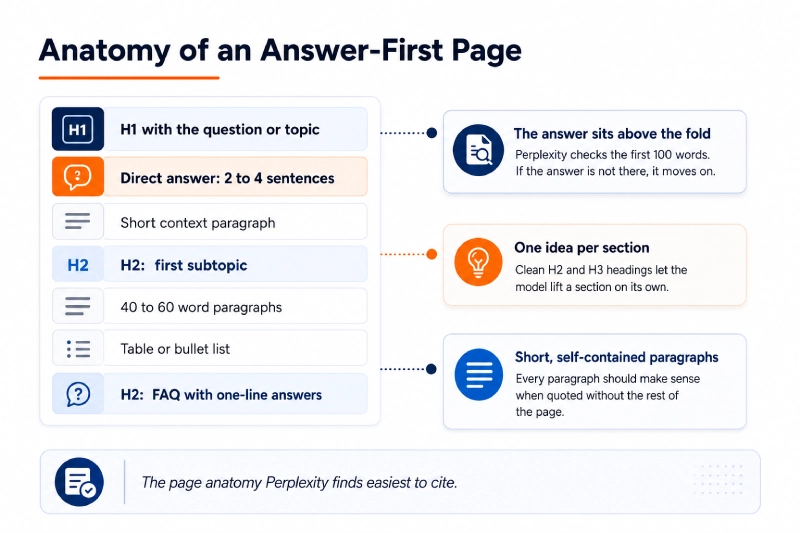
Figure 3: The page anatomy Perplexity finds easiest to cite.
Tactic 5: Build sections a model can lift cleanly
Perplexity quotes fragments, not full pages. Every section needs to make sense when pulled out on its own. In practice:
- One idea per H2 or H3. If a section covers two topics, split it.
- Paragraphs of 40 to 60 words. Long paragraphs blur the boundary of what the model can safely quote.
- Write self-contained sentences. ‘It also helps with this’ is unquotable; ‘FAQ schema also helps AI systems match questions to answers’ stands alone.
- Use tables for comparisons and numbers. Tabular data gets lifted into answers at a high rate because it is unambiguous.
- Phrase H2s as the questions people actually ask. The closer your heading is to the query, the easier the match.
Tactic 6: Add schema markup that matches the page
Schema gives the retrieval layer a machine-readable summary of what your page is and who stands behind it. The types that earn their place for AI search in 2026 are Article, Organization, Person for your authors, BreadcrumbList, and FAQPage. Google restricted FAQ rich results back in 2023, but FAQ markup still helps AI systems pair questions with answers, so keep it on informational pages.
One warning: your markup must say the same thing your visible page says. When schema and page copy disagree, trust in your markup drops across the whole domain. Run the Rich Results Test after every site release, and read the schema drift section of our technical SEO guide if you want the full checklist.
Pillar 3 / Authority
Tactic 7: Publish original data worth quoting
AI answers are built out of facts, and a fact with a number and a named source is the easiest thing in the world to cite. Sites that publish original research get referenced again and again because everyone else’s content points back to them.
You do not need a research department. A survey of 100 customers, a benchmark of tools you tested yourself, anonymised patterns from your own project data, or a price comparison you compiled by hand all qualify. Present each finding as a single clean sentence with the number in it, and publish a short methodology note so the finding is defensible. One quotable statistic outperforms a thousand words of opinion.
Tactic 8: Strengthen your entity signals
Perplexity’s reranker checks whether it can identify who you are and whether that identity is consistent across the web. This is entity SEO, and it is quietly one of the biggest gaps between sites that get cited and sites that do not.
- Describe your business the same way everywhere: your site, LinkedIn, Crunchbase, Wikidata, and your Google Business Profile.
- Add Organization schema with a sameAs array linking those profiles together.
- Give every article a named author with a real bio, credentials, and a Person schema entry. Anonymous content reads as low-trust.
- Add an llms.txt file at your site root describing what the site covers. It is a proposed standard; it takes half an hour, and there is no downside.
Tactic 9: Earn mentions in the places Perplexity trusts
Perplexity leans on a curated pool of sources it already trusts, and mentions from inside that pool act as votes for your domain. Backlinks still matter here, but as trust signals rather than raw ranking fuel.
- Pitch original data and expert commentary to industry publications. Earned media from credible outlets is the strongest single vote.
- Take part honestly in Reddit, Quora, and niche forums where your topics come up. Perplexity cites community threads heavily, and a genuinely helpful answer there can surface your brand directly.
- If you serve local customers, tend to your Yelp, TripAdvisor, and Google reviews. Perplexity pulls local answers straight from review platforms.
- Cite credible sources in your own content. Pages that reference trustworthy material read as part of the trusted web rather than an island.
Pillar 4 / Maintenance
Tactic 10: Refresh content on a schedule
Recency is one of Perplexity’s heaviest signals. Because it retrieves live for every query, a page updated last month can outrank a stronger page from last year, and industry tracking consistently shows citation share fading a few months after publication if a page is left alone.
- Put every money page on a refresh calendar, at a minimum once a quarter.
- Make real updates: new figures, new sections, corrected claims. Changing the date alone does nothing.
- Show a visible last-updated date on the page and keep the lastmod field in your XML sitemap accurate.
Tactic 11: Grow topic clusters, not one-off posts
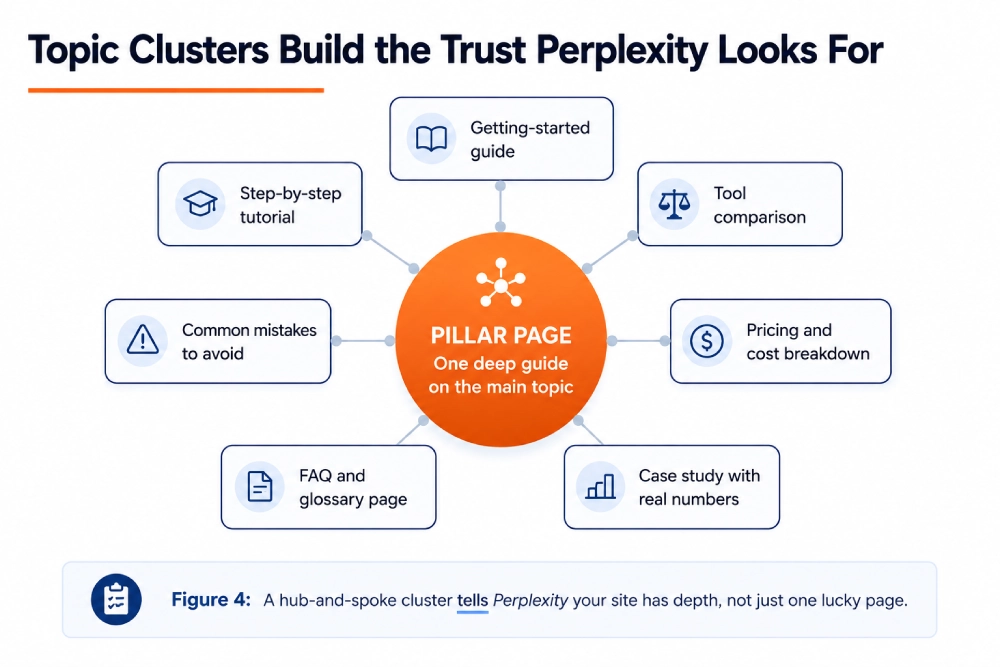
A single great article rarely earns steady citations. Perplexity rewards domains that show depth on a subject, so the reranker trusts a site with twelve interlinked pages on one topic far more than a site with twelve pages on twelve topics.
Build the classic cluster: one deep pillar page on your main subject, surrounded by supporting pages that each answer one narrower question, all linked to the pillar and to each other. Each new page in the cluster raises the trust score of every other page in it.
Tactic 12: Track your citations and adjust monthly
You cannot manage what you never measure, and AI visibility does not show up in a normal rank tracker. A simple monthly loop covers it:
- Run your 15 to 20 most valuable queries in Perplexity and log which sources it cites.
- Watch referral traffic from perplexity.ai in GA4. It is usually small in volume and high in intent.
- Open every page that was cited instead of yours and note what it does differently: fresher data, a cleaner direct answer, a stronger author, a table you lack.
- Feed those gaps back into your refresh calendar. When manual checks get tedious, AI visibility tools can automate the tracking.
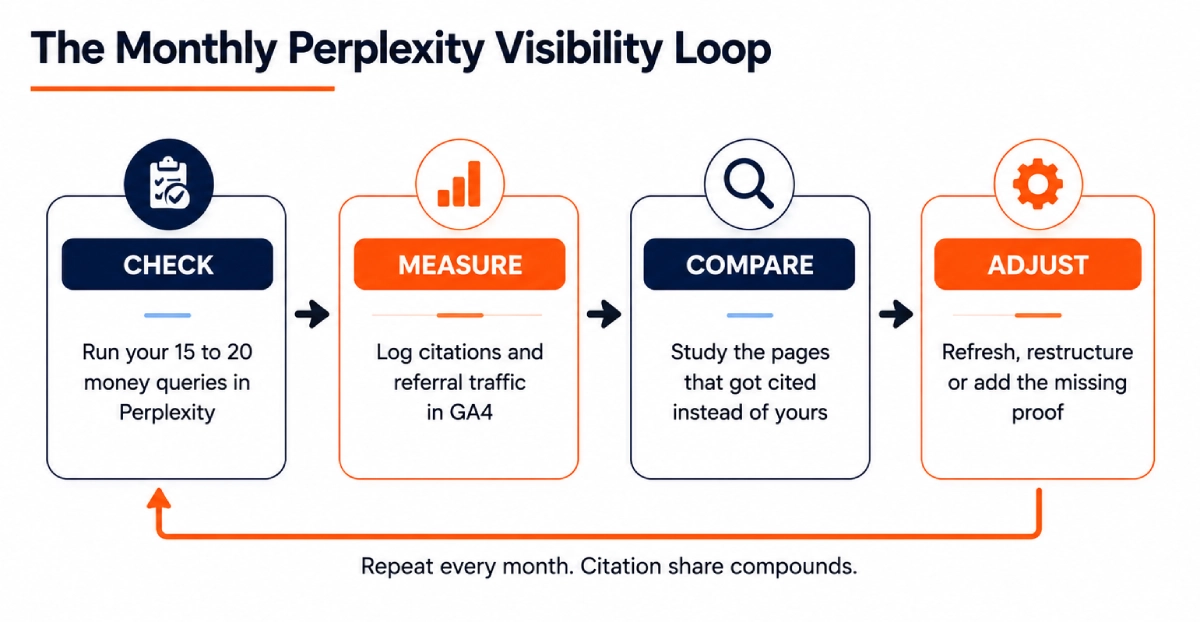
Figure 5: The monthly loop that turns tracking into compounding citation share.
The order of work
Your first 30 days, in order
- Week 1: Access
Verify PerplexityBot in robots.txt, CDN, and server logs. Run the view-source test on your ten most important pages and flag any JS-only content. - Week 2: Structure
Rewrite the opening paragraph of your top five pages into direct answers. Break long paragraphs, convert comparisons into tables, and turn H2s into real questions. - Week 3: Trust
Add or fix Article, Organization, Person, and FAQ schema. Align your business description across LinkedIn, Crunchbase, and your site. Publish author bios and an llms.txt file. - Week 4: Momentum
Plan one original-data piece, map your first topic cluster, set the quarterly refresh calendar, and run your first citation-tracking session as the baseline.
Give it time
Crawl and structure fixes can show up in Perplexity within days because retrieval is live. Authority signals move slower: expect two to three months before entity work and earned mentions change your citation share
Frequently Asked Questions
What is Perplexity AI and how is it different from Google?
Perplexity AI is an answer engine that writes one direct, sourced response to each question instead of listing links. Google ranks pages for people to click; Perplexity retrieves pages in real time, extracts the answer, and cites the three to eight sources it trusts most. Winning on Perplexity means being cited, not placed.
Do I need strong Google rankings to appear in Perplexity?
No, but it helps. Onely's 2026 analysis found an 82% overlap between Perplexity citations and Google AI Overview citations, so the same clean, answer-first pages tend to win on both. That said, Perplexity's own index is far smaller than Google's, which gives well-structured pages from newer sites a genuine opening.
How long does it take to get cited by Perplexity?
Structural fixes can change results within days to weeks because Perplexity retrieves live fdata or every query. Authority work, such as entity building, author profiles, and earned mentions, typically needs two to three months to shift citation share.
Should I block PerplexityBot to protect my content?
Only if you have a firm reason, because blocking it removes you from a growing discovery channel. If your concern is AI training rather than AI answers, allow PerplexityBot and block the training-focused crawlers such as GPTBot and Google-Extended instead.
Does FAQ schema still matter now that Google has restricted it?
Yes. Google limited FAQ rich results to government and health sites in 2023, but AI systems still use FAQ markup to match questions with answers. Keep the existing FAQ schema and add it to informational pages, alongside Article, Organization, and Person markup.
How do I check whether Perplexity is citing my website?
Run your most valuable customer questions in Perplexity each month and record which domains appear as sources. Pair that with GA4 filtered to referrals from perplexity.ai. Once you track more than a handful of queries, an AI visibility tool can automate the checks.
Is ranking on Perplexity the same as ranking on ChatGPT?
The foundations overlap, but the platforms weigh signals differently. Perplexity retrieves live and rewards freshness and clean extraction; ChatGPT leans more on training data and topical depth, and it attributes sources less often. Answer-first structure, entity clarity, and real authority serve you on both.