Two searches. Two completely different jobs.
Most people now flip between Google and a tool like ChatGPT, Perplexity or Gemini without noticing the switch. But the two are not the same act. This guide breaks down what you are actually doing when you type into a Google box versus when you prompt an AI search tool: the words you use, the machine’s response, and the work that lands back on you afterwards.
Key facts
- Google returns
- a ranked list of links plus AI Overviews
- AI search returns
- one synthesised answer with citations
- Your job on Google
- read, compare, decide
- Your job on AI
- verify, then act
Google searching vs AI searching what are you actually doing
When you use Google, you type a few keywords and the engine returns a ranked list of web pages that match, leaving you to open, read and compare them. When you use AI search, you write a full question in plain language and the tool reads several pages for you, then writes one combined answer. Google gives you sources; AI gives you a summary.
That single difference changes almost everything downstream: how you phrase the query, how long you spend, and how much you trust what comes back.
The words you type are not the same
Google rewards keywords. You strip a thought down to its bones: "razorpay kyc documents", "gst return due date december", "best laptop under 60000". Three or four words. You learned this habit because Google’s index matches terms, and extra words used to hurt more than help.
AI search rewards full sentences and context. You write like you’re briefing a colleague: "I run a 12-person D2C skincare brand on Shopify and I want to know which GST return I file monthly versus quarterly." The extra context is the point. The model uses it to shape the answer.
If you catch yourself typing a fragment into ChatGPT, you’re still searching like it’s Google. If you type a paragraph into Google, you’re wasting most of it.
What each machine does after you hit enter
Google matches and ranks. Its crawler has already indexed billions of pages, and when you search, it scores them against your keywords using signals like links, freshness and page quality, then orders the results. You get ten blue links, some ads, maybe a featured snippet, and increasingly an AI Overview at the top that summarises before you scroll.
AI search reads and writes. A tool like Perplexity runs its own search in the background, pulls the top few pages, then a language model reads those pages and drafts a single answer, usually with numbered citations you can click. The answer did not exist before you asked. It was generated on the spot.
10
blue links Google has shown per page for two decades, before you scroll or click anything.
Google shows you where answers live. AI search tells you the answer and shows the receipts underneath. One is a library catalogue. The other is a research assistant who read the books and wrote you a note.
The work that lands back on you
Both tools move labour around, just to different points.
With Google, the effort comes after the search. You open four tabs, spot the ad from the guide, notice one page is from 2019, cross-check a price on two sites, and form your own view. You are the filter. That takes time, but you see the raw sources and their bias directly.
With AI search, the effort comes before you trust it. The answer arrives fast and reads confidently, so the temptation is to accept it. But models still get things wrong, blend an outdated figure with a current one, or cite a page that doesn’t actually say what the answer claims. Your job moves to verification: click the citations, check the date, confirm anything that costs money or carries legal weight.
| Stage | AI search | |
|---|---|---|
| Query style | Keywords, 3-5 words | Full question with context |
| Machine’s job | Match and rank pages | Read pages, write one answer |
| What you get | List of links | Synthesised answer with citations |
| Where your effort goes | Reading and comparing after | Verifying and phrasing |
| Best for | Browsing, shopping, checking a site | Explaining, summarising, comparing |
When Google still wins
Google beats AI search for anything where you need the actual page, not a description of it. You want the RBI’s own circular, the exact Razorpay pricing page, a specific product listing to buy, or a business’s live phone number and hours. A synthesised answer is a detour. You want the source itself, and Google takes you straight there.
It also wins for exploratory browsing. Say you’re researching a competitor. Ten links let you wander, spot their careers page, their reviews and their pricing all at once. A single AI answer collapses that into a tidy paragraph and hides the messy detail you were actually hunting for.
Local intent is another one. "Chemist near me open now" pulls the map pack, live timings and directions. That’s structured data Google holds and displays instantly. If you run a local business, setting up your Google Business Profile properly still matters more than any AI tool.
When AI search saves you real time
AI search wins when the answer sits scattered across several pages and you don’t want to assemble it yourself. "Compare Razorpay, Cashfree and PhonePe pricing for a startup doing ₹5 lakh a month" would take you six tabs and twenty minutes on Google. An AI tool drafts the comparison in one go, with links to check.
It also wins for anything that needs rephrasing rather than retrieval: summarise this 40-page report, explain GST input credit like I’m new to it, rewrite this in simpler English. Google can’t do that. It can only point you at a page that might.
Say you’re a marketing head who just got a 30-page vendor proposal at 6pm. Google can’t summarise it. An AI tool can pull out the pricing, the terms and the exit clause in ninety seconds, and you decide whether it’s worth reading in full. That’s the honest use case: triage, not final judgement.
Watch out: Never act on an AI answer for anything with money, tax or legal consequences without opening the citation and confirming the date. Models mix current and outdated figures without flagging it.
What this means if you run the website people search for
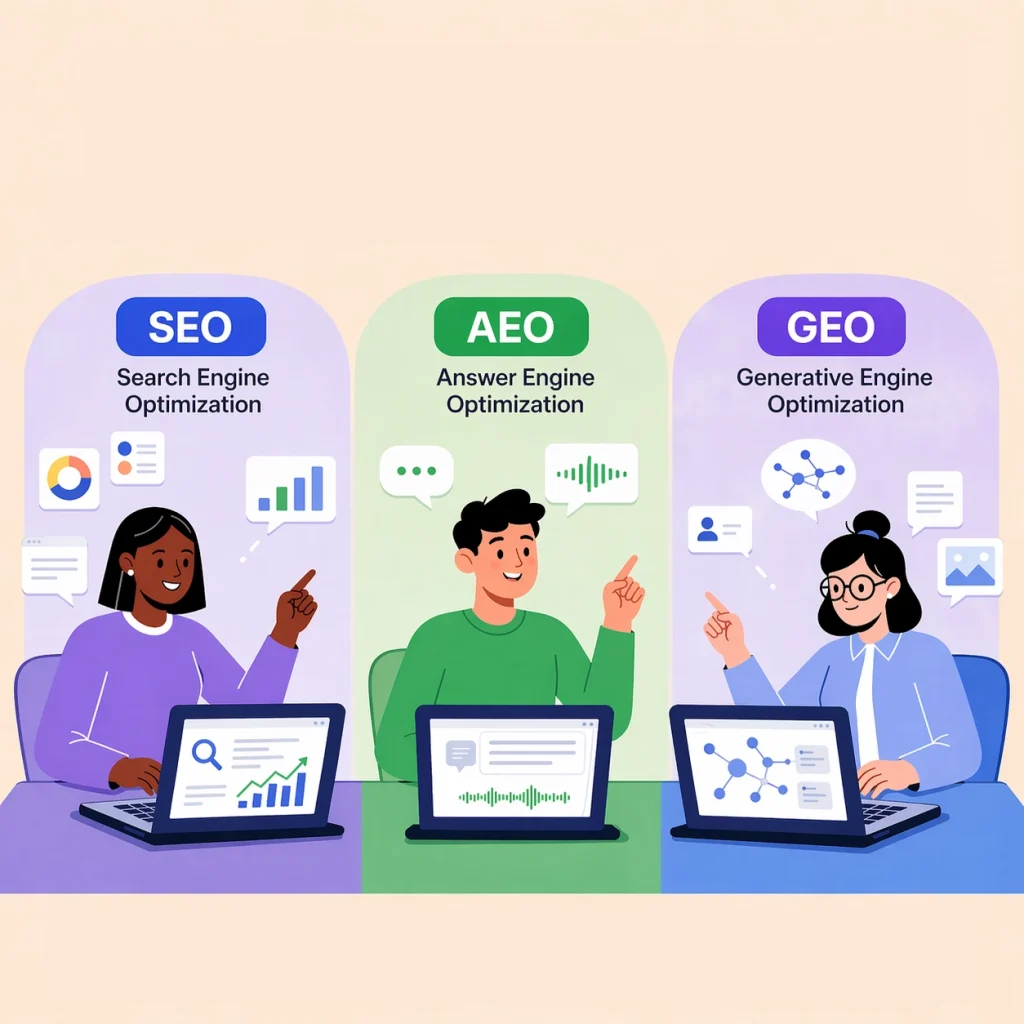
The split matters for anyone whose customers use both. On Google, you compete for a ranked position and a click. On AI search, you compete to be one of the sources the model reads and cites, which is a different game with different signals. We cover the practical side of that in our guide on how to rank on Perplexity, and the wider strategy in our breakdown of SEO vs AEO vs GEO.
Google visibility gets you clicks. AI visibility gets you citations. The tactics only partly overlap. Clear structure, direct answers near the top of a page, and factual sentences an engine can lift help with both. Keyword stuffing helps with neither anymore.
Google’s own documentation on how Search works describes the crawl, index and rank pipeline, and it’s worth reading once if you want the mechanics straight from the source (Google Search Central).
A simple rule for daily use
Use Google when you know roughly what you want and need to reach the actual page: a product, a form, a business, an official document. Use AI search when you want something explained, summarised or compared across sources and you’d otherwise open six tabs. Then verify anything that matters.
Most days you’ll do both, often for the same task. You might ask an AI tool to compare three payment gateways, then jump to Google to open the winner’s real pricing page and sign up. The two aren’t rivals. They’re different steps in the same habit, and knowing which one you’re actually using stops you from phrasing the query wrong or trusting the answer too fast.
Frequently asked questions
Is AI search going to replace Google entirely?
Not soon. Google still owns local results, shopping, live business data and direct access to actual pages, which AI answers can’t replace. Most people now use both: AI search for explanations and comparisons, Google to reach the real source. Google is also adding AI Overviews to its own results, so the line is blurring rather than one side winning outright.
Why does ChatGPT sometimes give me wrong or outdated information?
Language models generate answers from patterns and, when connected to search, from pages they read in the moment. They can blend an old figure with a current one, misread a source, or cite a page that doesn’t support the claim. Always click the citation and check the date before acting on anything involving money, tax or law. Treat the answer as a fast draft, not a verified fact.
Do I need to pay for AI search tools or is Google’s AI Overview enough?
For casual questions, Google’s free AI Overviews and free tiers of ChatGPT, Perplexity or Gemini cover most needs. Paid tiers add newer models, longer context and fewer limits, which matters if you research heavily or upload documents daily. Try the free versions first; most Indian users and small teams never hit the point where paying is worth it.
Why do my Google keyword searches fail inside ChatGPT?
Because AI tools read context, not keywords. A three-word fragment gives the model nothing to work with, so it guesses. Write a full sentence with your situation and what you actually want to know. The more you add, the sharper the answer, which is the opposite of how you learned to search on Google.
Which is better for shopping research, Google or AI search?
Google is better for the final step because you need actual product listings, live prices and buy buttons. AI search helps at the start when you want a shortlist or a feature comparison across models. A common flow is asking AI to narrow ten options to three, then using Google to open those three listings and check current stock and price.
Can AI search see live, real-time information like prices or news?
Only if the tool is connected to live web search, which Perplexity and the search-enabled modes of ChatGPT and Gemini are. Even then it reads a snapshot of a few pages, not a live feed, so a price or timing can be stale by minutes. For anything truly live, like stock or business hours, go to Google or the source directly.
Why does AI search cite sources but Google mostly shows links?
Because they do different jobs. Google’s job is to rank and hand you pages, so links are the product. AI search reads those pages and writes one answer, so it shows citations to prove where the answer came from and let you verify. The citations are the AI tool’s version of accountability, since the answer itself is generated rather than retrieved.
Should my business optimise for Google or for AI search?
Both, because your customers use both. Google visibility earns clicks; AI visibility earns citations inside answers. The overlap is clear page structure, direct answers near the top and factual, quotable sentences. The difference is that AI engines reward being a trusted source they can lift from, while Google still rewards links and page authority. Neither rewards keyword stuffing anymore.
Is it safe to search for medical or legal questions on AI tools?
Use them to understand terms and options, never for a final decision. AI answers can sound authoritative while being incomplete or wrong for your specific case. For medical or legal matters, treat the AI answer as background reading, then confirm with a qualified professional or the official source. The confident tone is not a measure of accuracy.
Why do I get different answers from Google, ChatGPT and Perplexity for the same question?
Each tool reads different pages and uses a different model to write the answer, so results vary. Google shows ranked links plus its own summary; ChatGPT and Perplexity each pick their own sources and phrase things their own way. For anything important, cross-check two tools and open the underlying citations rather than trusting a single answer.