
Most people who mix SEO and AI end up with generic, thin content that Google eventually pushes down. That was my worry too, for a long time.
What changed my mind wasn’t AI writing blog posts for me. It was building a set of SEO AI agents that each handle one specific, repeatable task — the kind of work that used to eat hours every week without moving the needle much on its own. Once each agent has a narrow job and access to real data from tools like Google Search Console and Ahrefs, the output stops being generic and starts being useful.
Here are seven ways I put AI agents for SEO to work across client accounts at Creative Nexus, and what each one actually changes for a website’s growth.
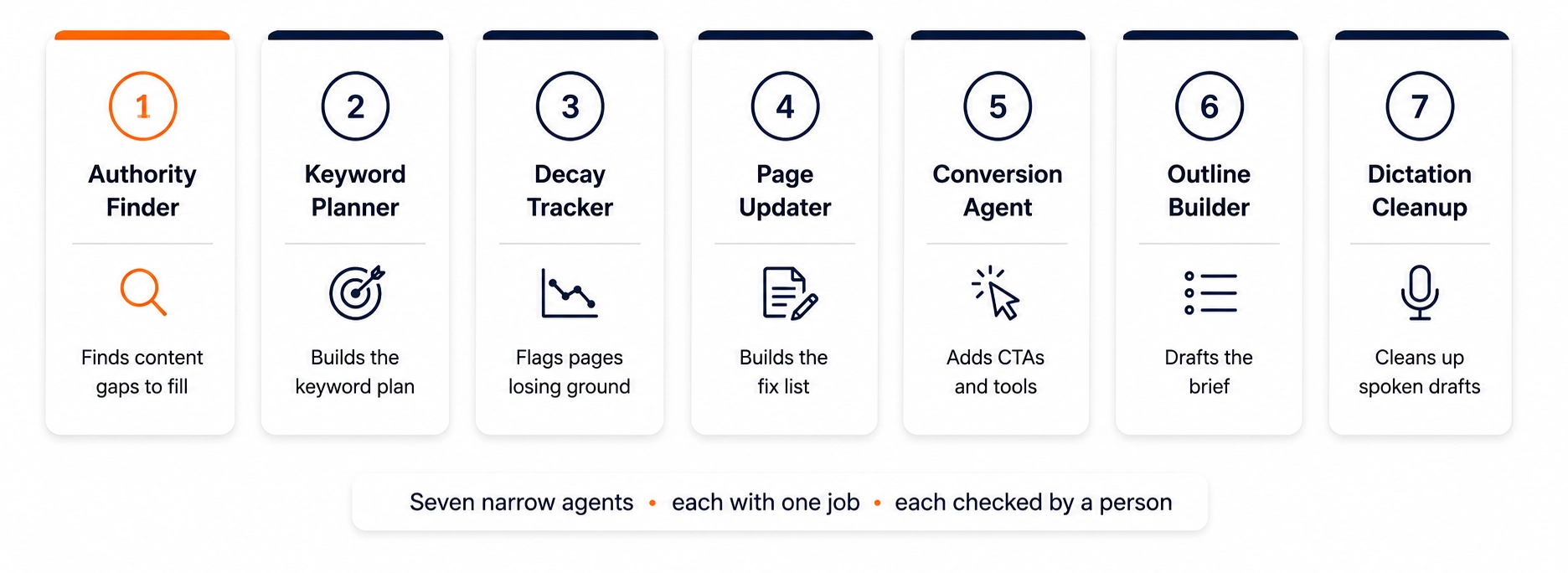
01 Finding Where a Site Already Has Authority
Before adding more content to a site, it helps to know where Google already trusts it. I run a Search Console export through an agent trained to group pages by topic and flag clusters where the site is already ranking well.
- Groups existing pages into topic clusters
- Flags clusters where the site already ranks well
- Suggests adjacent subtopics worth covering next.
- Content planning shifts from guessing to building on strength
- Sites that go deep on a few themes show faster SEO ranking improvement
02 Building a Plan From Real Business Data
A content plan is only as good as the business context behind it. I feed an agent the client’s audience, product lines, and target categories, then cross-reference that against live keyword data pulled through Ahrefs.
Target audience and buyer profile
Product or service list
Live keyword volume, difficulty, and intent data
A shortlist weighted toward buying intent, not just volume
A full day of manual research reduced to under an hour of review
03 Catching Pages That Are Losing Ground
Rankings don’t stay still. A page that performed well six months ago can quietly lose position as competitors publish fresher content or the page itself goes stale.
Compares Search Console data across two time windows
Flags pages with the largest drop in clicks or position
- Ranks flagged pages by traffic lost
Runs on a recurring schedule, not once a year
The fix is usually a targeted update, not a rewrite
04 Turning Flagged Pages Into a Fix List
Once a page is flagged, a second agent takes over and builds a specific, actionable to-do list for the writer.
Keywords with impressions but low clicks
Meta title and heading updates
- Missing internal links to add
- Outdated facts or examples to refresh
- Flatlined pages have doubled daily clicks within a couple of months
- The agent hands over a list; a writer does the editing
05 Adding Elements That Drive Conversions
Ranking well and converting well are two different problems. For pages that already pull solid traffic, an agent suggests and builds simple on-page elements as custom code.
- Comparison tables
- Simple calculators or interactive tools
- Contextual calls-to-action placed mid-content
- Interaction sends stronger engagement signals to search engines
- Can help a page hold or improve its position over time
06 Drafting Outlines Before Writing Starts
I don’t have AI write finished articles. Client work needs a real point of view and firsthand expertise. But before a writer starts, an agent builds a structured outline.
- Takes a target keyword and content format
- Pulls the client’s past content to match tone and structure
- Produces a section-by-section brief
- Writers never start from a blank page
- Nobody edits down AI-generated prose
07 Cleaning Up Dictated Drafts
A good chunk of our long-form content starts as dictation rather than typing, since talking through an argument is often faster than typing it out.
- Fix grammar, spelling, and punctuation only
- Leave tone, word choice, and sentence structure untouched
- Saves the most time day to day of any agent on this list
- Keeps the piece sounding like the person who wrote it
What Ties These Together
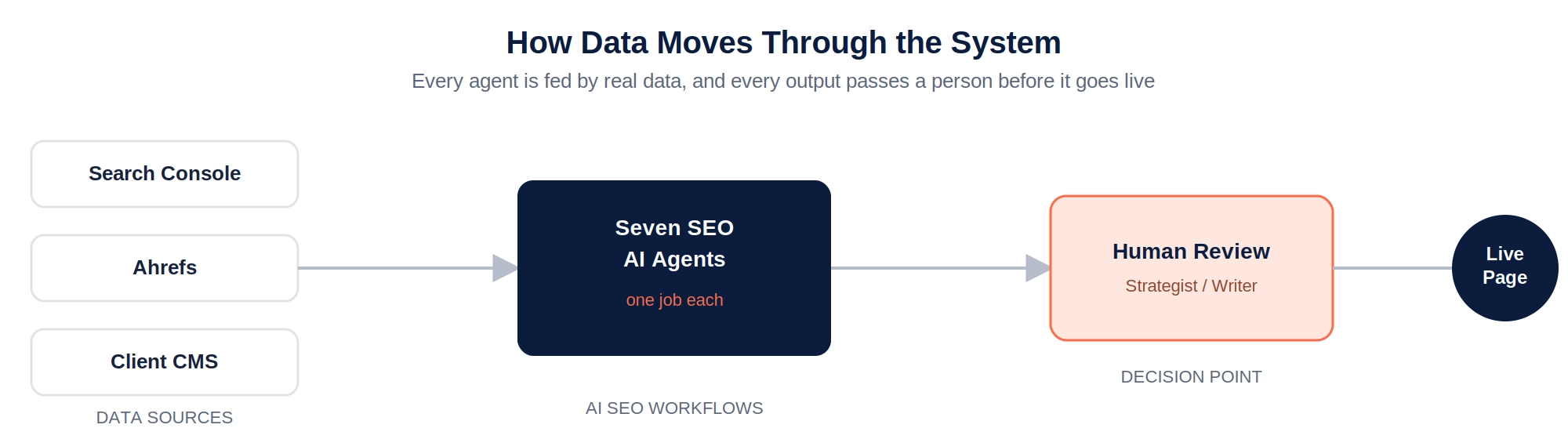
AI Agents: What They Do and How They Help a Business
Data sources feed the agents; a person reviews before anything publishes
- Narrow scope — each agent handles one task, not a whole workflow
- Real data in — Search Console, Ahrefs, and client context feed every agent
- Human review — a person checks output before anything goes live
- No auto-publishing — AI drafts and flags; writers and strategists decide
If you’re weighing where to start, a content decay check and a keyword plan built from real business context tend to show results fastest, since both feed directly into pages close to ranking already. Conversion elements and outline agents are worth adding once that foundation is in place.
Frequently Asked Questions
What is an SEO AI agent, exactly?
It's an AI assistant built around one specific SEO task, with access to real data and clear instructions on how to handle that task. It's narrower than a general chatbot and different from a fixed automation script, since it can work through a problem rather than just follow rigid steps.
How is an SEO AI agent different from a normal automation workflow?
A workflow tool like Zapier or Make runs a fixed sequence of steps and breaks if something doesn't match. An agent is triggered by a prompt, has access to tools and data, and adjusts its approach within the task it's been given.
Do I need to know how to code to build one?
No. Most of the work is documenting how you already do a task and turning that into clear written instructions. Tools like Claude or Gumloop handle the rest without requiring custom development.
Which SEO tasks are best suited to AI agents?
Yes, and they often see the clearest benefit, since a s
Repeatable, data-heavy tasks work best: keyword research, technical audits, rank tracking, content decay checks, and outline building. Tasks that need judgment about brand voice or strategy still need a person driving the decision.
mall team feels repeating work the most. Ready-made tools mean you don't need engineers to start. Pick one task rather than trying to automate everything.
Can AI agents replace an SEO strategist?
No. Agents handle research, monitoring, and drafting. Deciding what a brand should say, which markets to prioritise, and how to respond to a competitor's move still needs someone who understands the business.
Will Google penalise a site for using AI in its SEO process?
Google's guidance focuses on content quality, not how it was produced. Thin or unhelpful content is the risk, whether it's written by a person or generated by AI. Using AI agents for research and monitoring, with a person reviewing anything published, doesn't carry that risk.
What data should feed an SEO AI agent?
Google Search Console exports, Ahrefs or Semrush keyword data, and real business context such as the target audience and product list. Agents built on real data produce far more useful output than ones run on a general prompt alone.
How often should a content decay check run?
Every three to six months is a reasonable baseline for most sites. Larger sites with frequent publishing can benefit from a monthly check so declining pages get caught before the drop compounds.
What's a reasonable first AI SEO agent to build?
A content decay checker or a keyword research agent tends to show value fastest, since both plug directly into pages that are already close to ranking.
Do AI SEO agents need constant supervision?
Not constant, but regular. A weekly or monthly check-in on what the agent flagged is usually enough, with closer review before anything the agent drafts gets published.
What is SEO automation, and how is it different from an AI agent?
SEO automation is the broader idea of using software to handle repetitive SEO tasks. AI agents are one way to build that automation, with more flexibility than a fixed script because they can interpret data rather than just move it from one place to another.
Can AI agents write blog content directly?
They can draft outlines and structure, but finished articles still benefit from a person's firsthand experience and point of view. Fully AI-written content tends to read as generic, which works against both readers and rankings.
What tools are commonly used to build AI SEO workflows?
Claude and similar chat-based platforms work well for individual use. Tools like Gumloop add the ability to connect multiple data sources and share agents across a team, which suits agencies running the same process for several clients.
How much time does an AI SEO agent actually save?
It varies by task. Keyword research that used to take a full day can often be reviewed in under an hour. Technical audits that ran quarterly can run weekly instead, since the agent does the repetitive scanning.
Is MCP required to use AI agents for SEO?
Not required, but it helps. MCP (Model Context Protocol) lets an agent read live data from tools like Search Console or a CMS instead of relying on manually pasted information, which makes the output more accurate.
How do AI agents help with SEO ranking improvement specifically?
They catch problems faster (declining pages, missing internal links, technical errors) and surface opportunities (content gaps, high-impression low-click keywords) that would otherwise take a person much longer to find manually.
Can small businesses use SEO AI agents, or is this only for agencies?
Small businesses can use the same approach at a smaller scale, starting with one agent for one task, such as a monthly Search Console review, before expanding further.
What's the biggest risk in using AI agents for SEO?
Publishing agent output without review. Agents are good at finding patterns and drafting structure, but a person still needs to confirm the recommendations make sense for the brand and the audience before anything goes live.
How do AI agents handle technical SEO audits?
An agent can crawl a site on a schedule and flag issues like broken links, missing meta data, and slow-loading pages. This turns a task that used to happen once a quarter into an ongoing, low-effort check.
Can AI agents help with content specifically written for AI search tools like ChatGPT or AI Overviews?
Yes. An agent can review whether a page's structure and direct-answer sections make it easy for AI systems to cite, which is a newer but growing part of search visibility.