
Video is everywhere today—from Instagram Reels and YouTube ads to corporate films, product demonstrations, customer testimonials, and brand stories.
But producing an effective business video involves much more than simply recording footage with a camera.
Video production is the complete process of planning, creating, filming, editing and delivering video content for a specific purpose. For businesses, that purpose might be increasing brand awareness, explaining a product, generating leads, training employees, attracting investors or improving conversions.
Professional video production services bring strategy, storytelling, cinematography, sound, editing, animation and marketing together to turn a business idea into content people can understand and remember.
In this guide, we will explain what video production is, how the video production process works, different types of business videos, how much planning is involved, how to choose a video production company and how businesses can get better results from video content.
What Is Video Production?
Video production is the process of creating video content from an initial idea through to the final edited video.
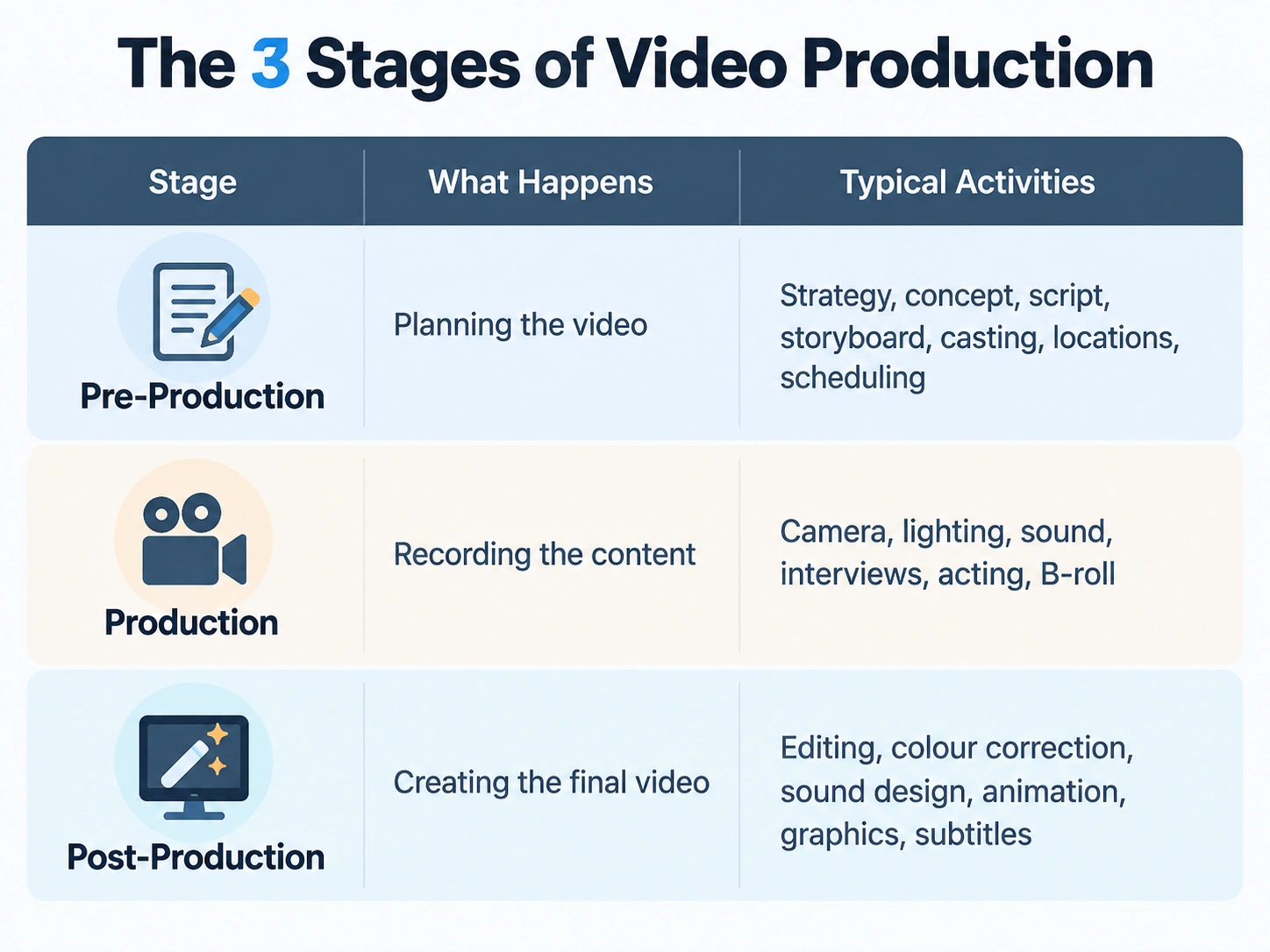
It normally has three major stages:
Pre-Production → Production → Post-Production
Each stage serves a different purpose.
For a business, professional video production starts even before a camera is selected.
The first question should be:
“What business result should this video help us achieve?”
Once that objective is clear, everything from the script to the video length, production style and distribution platform can be planned around it.
How Does the Video Production Process Work?
A professional video production company generally follows a structured workflow.
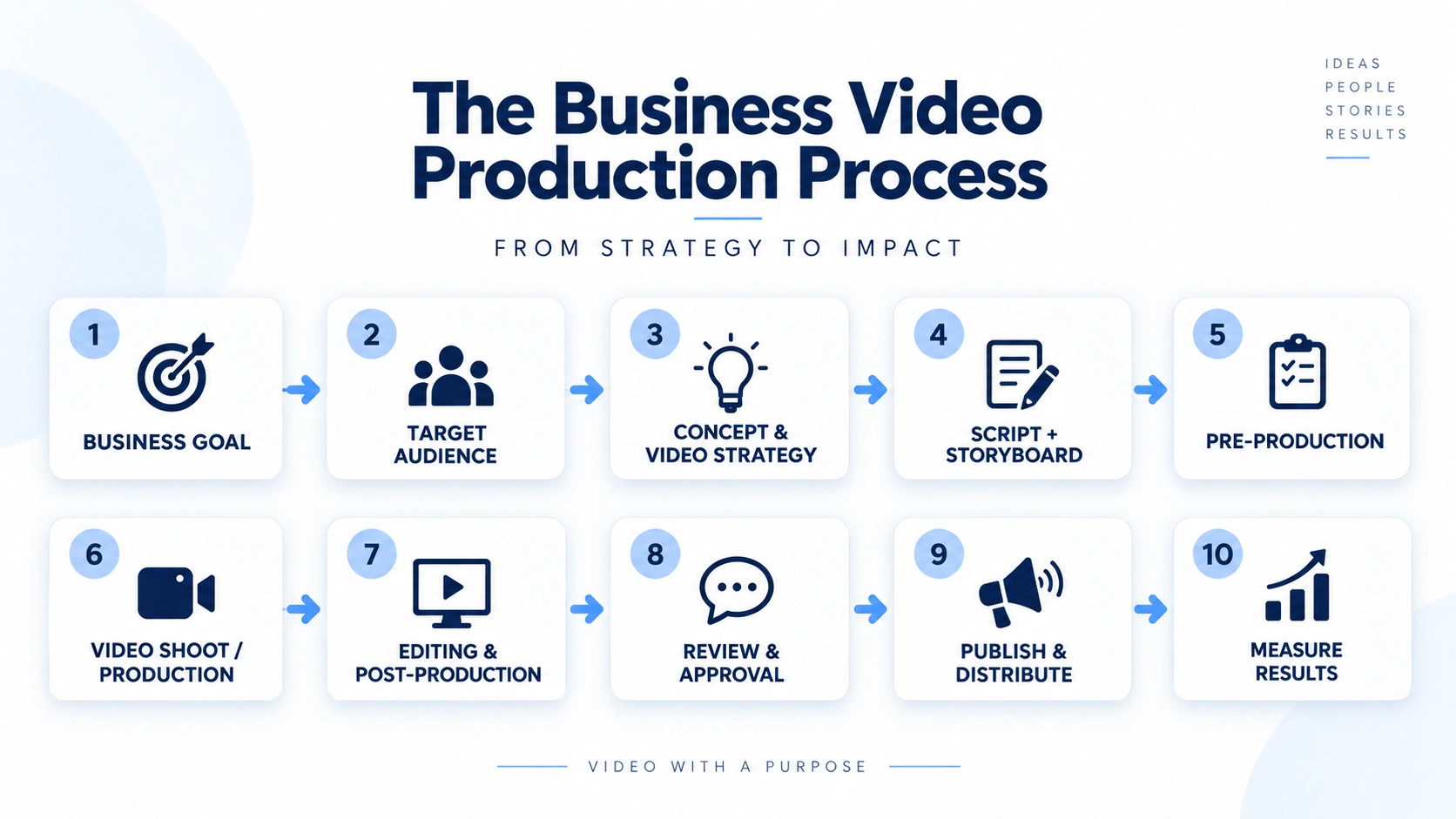
This structure prevents businesses from spending money on a great-looking video that does not actually support their marketing or communication goals.
Let’s understand each stage.
Stage 1: Pre-Production
Pre-production is one of the most important parts of the entire video production process for businesses.
It is where the video is planned before filming begins.
Good pre-production saves time, reduces unnecessary shooting costs and prevents major changes during editing.
1. Understanding the Business Objective
First, determine what the video needs to accomplish.
For example:
- Generate leads
- Introduce a company
- Explain a complicated product
- Promote a service
- Launch a new product
- Increase brand awareness
- Recruit employees
- Train employees
- Build investor confidence
- Generate engagement on social media
A video created for LinkedIn brand awareness will be very different from a product demonstration designed for a landing page.
2. Understanding the Target Audience
Before writing the script, understand who will watch the video.
Consider:
- Who are they?
- What problems are they facing?
- What information are they searching for?
- What objections might they have?
- Which platforms do they use?
- What action should they take after watching?
The more clearly a business understands its audience, the easier it becomes to create relevant video content.
3. Developing the Video Concept
The production team now decides how the message should be presented.
The concept might involve:
- Customer storytelling
- Founder interviews
- Product demonstrations
- Animation
- Live-action scenes
- Employee interviews
- Voice-over storytelling
- User-generated content
- A combination of live footage and motion graphics
A professional video production company should recommend the format based on your objective rather than simply following the latest visual trend.
4. Scriptwriting
A script turns the concept into a clear narrative.
A typical business video script contains:
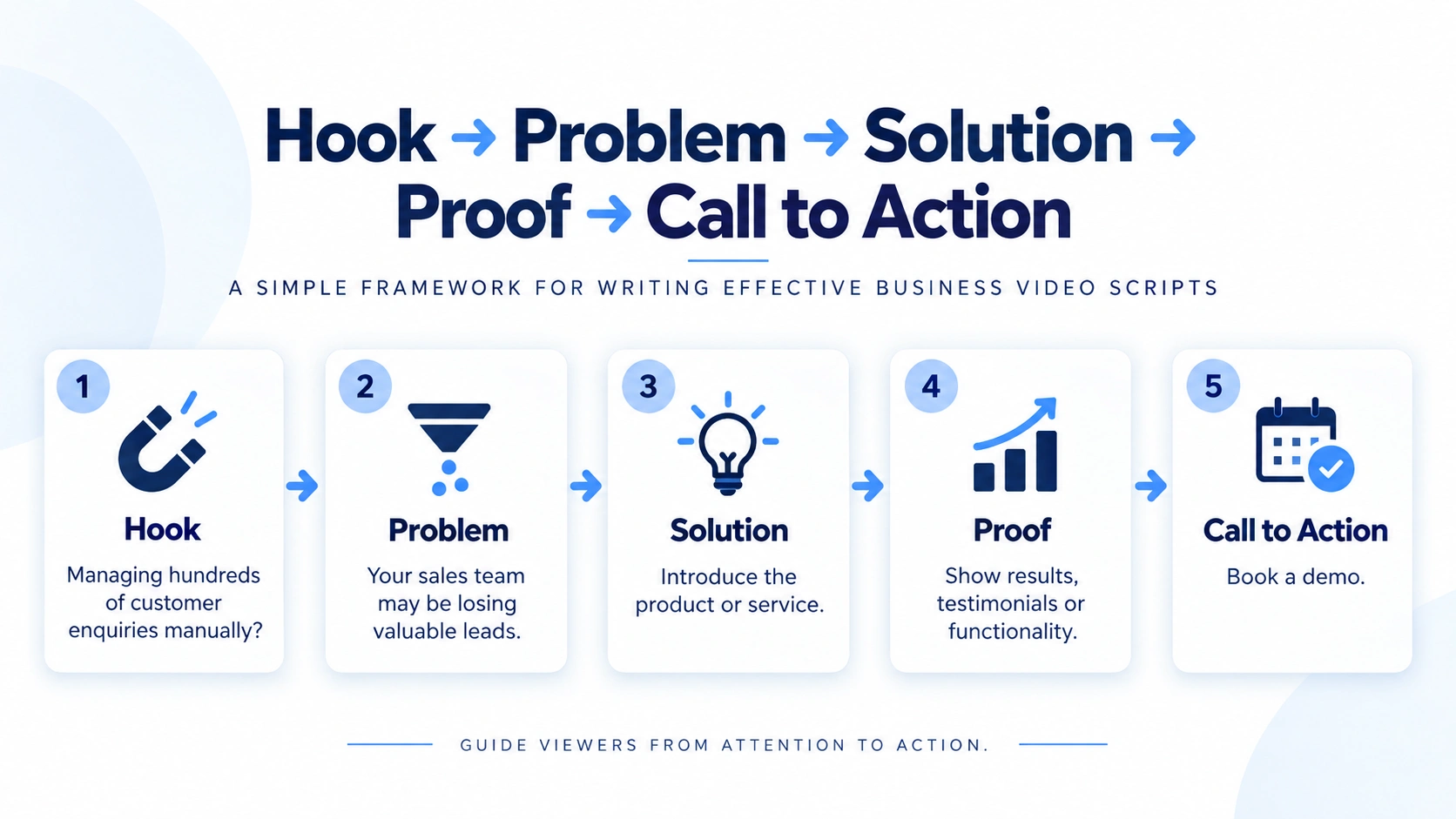
The script also helps estimate the final video length and identify what needs to be filmed.
5. Storyboarding
A storyboard visually maps important scenes before production.
It may show:
- Camera angles
- Characters
- Locations
- Product shots
- Text overlays
- Animations
- Scene transitions
Think of a storyboard as the visual blueprint for your video.
6. Production Planning
Once the concept and storyboard are approved, the team handles operational planning.
This may include:
- Location scouting
- Casting actors or models
- Scheduling
- Camera selection
- Lighting equipment
- Sound equipment
- Props
- Makeup
- Wardrobe
- Permissions
- Travel arrangements
- Production crew
For larger corporate films or advertisements, this stage can involve significant coordination.
Stage 2: Production
Production is the stage where the actual video is filmed.
Depending on the project, a production team may include:
- Director
- Producer
- Cinematographer
- Camera operators
- Lighting technicians
- Sound engineer
- Production assistants
- Actors
- Models
- Makeup artists
- Art director
Smaller projects may require only a compact crew.
During filming, the team captures both the main footage and additional supporting shots known as B-roll.
For example, in a manufacturing corporate film, the primary footage might be an interview with the managing director.
B-roll could include:
- Factory operations
- Employees working
- Machinery
- Products
- Quality-control processes
- Warehousing
- Office environment
These supporting visuals make the final video much more engaging.
Stage 3: Post-Production
Once filming is completed, the raw footage moves into post-production.
This is where separate recordings are transformed into one polished story.
Post-production may include:
- Video editing
- Shot selection
- Colour correction
- Colour grading
- Sound mixing
- Background music
- Voice-over
- Motion graphics
- 2D animation
- 3D animation
- Visual effects
- Logo animation
- Subtitles
- Text overlays
- Transitions
Post-production can dramatically change how professional a video feels.
A good editor doesn’t simply join clips together. The editor controls the pace, emotional flow and clarity of the story.
Video Production vs Video Marketing: What Is the Difference?
Businesses often use these terms interchangeably, but they are different.
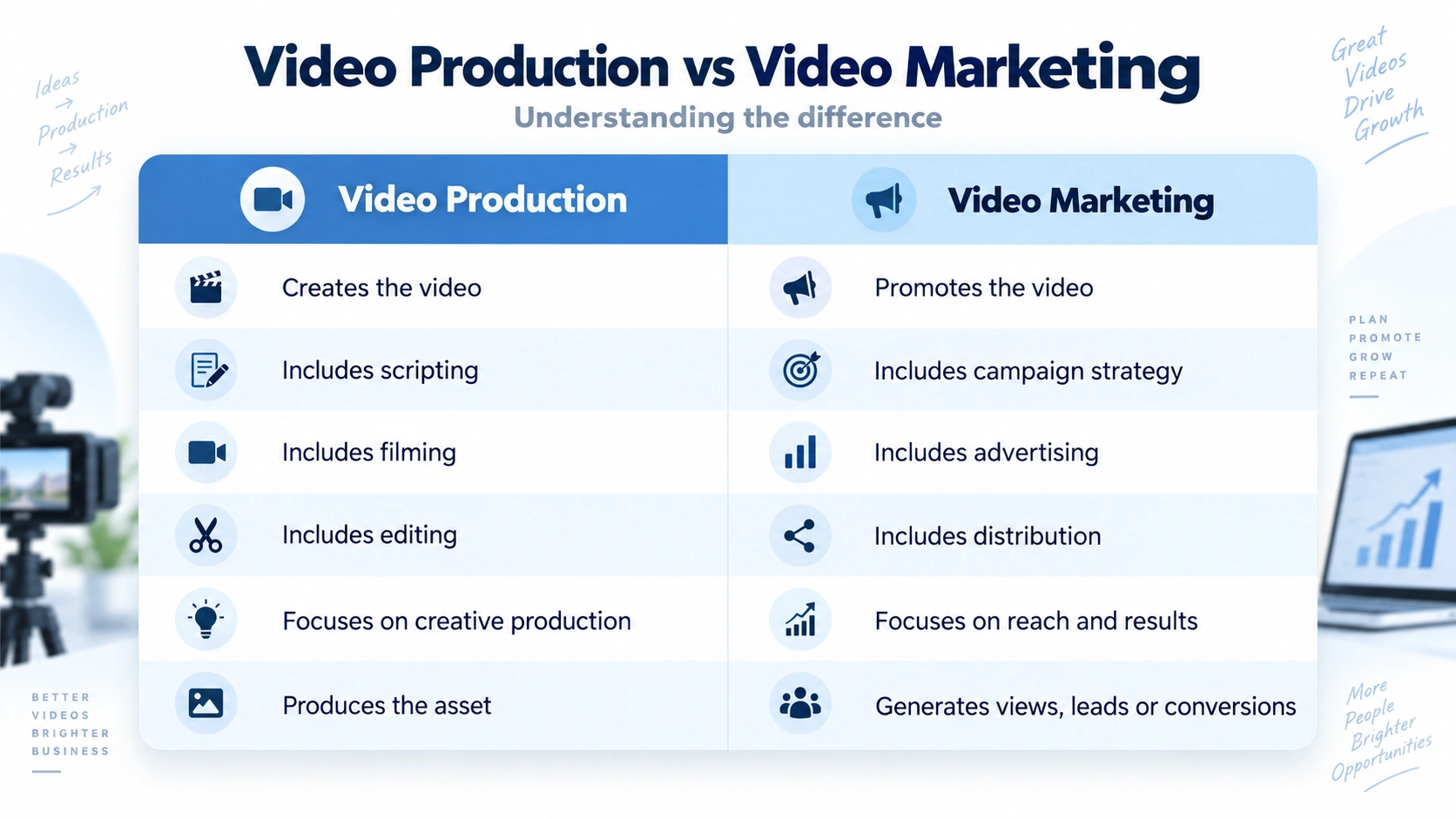
Video production creates the content.
Video marketing determines how that content reaches the right audience.
For a deeper understanding of distribution and promotion, businesses should also explore Creative Nexus’ Ultimate Guide to Video Marketing.
Why Is Video Production Important for Businesses?
Businesses increasingly compete for attention across websites, search engines, social media, email, marketplaces and advertising platforms.
Video can communicate complex messages faster than many other formats.
Here are some major business applications.
Build Brand Awareness
A strong brand film can communicate your company’s personality, mission, culture and value proposition.
Instead of simply telling people what your organisation represents, video allows you to show it.
Explain Complex Products
Some products or services cannot be easily explained through static images.
This is especially common in:
- SaaS
- Technology
- Fintech
- Manufacturing
- Healthcare
- Engineering
- B2B services
Product demonstration and explainer videos make complicated ideas easier to understand.
Increase Customer Trust
Potential customers often want to know who they are dealing with.
Videos featuring:
- Founders
- Employees
- Customers
- Offices
- Manufacturing facilities
- Real projects
can give audiences a clearer understanding of the company behind a product or service.
Support Sales Teams
Videos can become powerful sales-enablement assets.
A sales team can use:
- Product videos
- Customer testimonials
- Explainer videos
- Corporate films
- Case-study videos
during outreach, presentations and follow-ups.
Improve Social Media Content
Social channels are highly visual environments.
One professional video shoot can often generate multiple content assets.
For example:

Businesses planning video-led social campaigns can also refer to Creative Nexus’ guide on Social Media Marketing Tips to Drive Sales and Build Brand Loyalty.
Types of Video Production Services for Businesses
Businesses do not necessarily need the same type of video.
The right format depends on the objective.
| Video Type | Best Used For | Common Platforms |
|---|---|---|
| Corporate Video | Brand communication | Website, LinkedIn, presentations |
| Brand Film | Storytelling & awareness | Website, YouTube, campaigns |
| Product Video | Product promotion | Website, e-commerce, ads |
| Explainer Video | Explaining complex ideas | Website, YouTube, sales |
| Testimonial Video | Building credibility | Website, LinkedIn, ads |
| Social Media Video | Engagement & awareness | Instagram, LinkedIn, Facebook |
| TV Commercial | Mass-market advertising | Television, OTT |
| Animated Video | Explaining abstract concepts | Website, YouTube, presentations |
| Training Video | Employee/customer education | LMS, internal platforms |
| Event Video | Event promotion & documentation | LinkedIn, YouTube, website |
| Recruitment Video | Employer branding | LinkedIn, career pages |
| UGC Video | Social proof & advertising | Instagram, TikTok, Meta Ads |

1. Corporate Video Production
Corporate videos communicate information about a company, its people, culture, operations, products or achievements.
Common examples include:
- Company profile videos
- Factory videos
- Founder interviews
- Investor videos
- Company culture videos
- CSR videos
- Employee training videos
- Leadership communication
- Annual-report videos
Businesses looking specifically for professional corporate films can explore Creative Nexus’ Corporate Video Production Services.

2. Product Videos
Product videos show the product instead of simply describing it.
They may demonstrate:
- Features
- Benefits
- Use cases
- Installation
- Product quality
- Before-and-after results
These videos are useful for e-commerce stores, SaaS companies, manufacturers and consumer brands.

3. Explainer Videos
Explainer videos simplify ideas that might otherwise take several paragraphs to communicate.
They can use:
- Live action
- 2D animation
- 3D animation
- Motion graphics
- Screen recording
- Whiteboard animation
Explainers work particularly well for technical products, software platforms and new services.

4. Customer Testimonial Videos
Instead of the company talking about itself, testimonial videos allow customers to share their experience.
A strong testimonial might explain:
Problem → Experience → Solution → Result
This makes testimonials useful in the middle and bottom stages of the marketing funnel.
For a deeper understanding of those stages, read Creative Nexus’ guide to ToFu, MoFu and BoFu marketing.

5. Social Media Videos
Social video production usually focuses on quick, platform-native content.
This may include:
- Instagram Reels
- YouTube Shorts
- LinkedIn clips
- Founder videos
- UGC videos
- Educational content
- Behind-the-scenes videos
Unlike a corporate film, social videos normally need to grab attention very quickly.

6. Promotional Videos and Video Ads
Promotional videos are created to encourage a specific action.
Examples include:
- Buy now
- Register
- Book a demo
- Download an app
- Attend an event
- Request a quote
Video ads may be created for Google, YouTube, Meta, LinkedIn or other advertising platforms.

7. 2D and 3D Animation
Not everything can be filmed.
Animation becomes useful when businesses need to demonstrate:
- Internal machinery
- Architectural concepts
- Product mechanisms
- Software processes
- Medical procedures
- Data
- Abstract concepts
It can also create visual experiences that would be expensive or impossible to film physically.
How Video Fits Into the Marketing Funnel
Video shouldn’t be treated as one isolated marketing asset.
Different videos can support different stages of the customer journey.
VIDEO MARKETING FUNNEL
AWARENESS — ToFu
Brand films
Social videos
Educational videos
Short-form videos
↓
CONSIDERATION — MoFu
Explainer videos
Product videos
Webinars
Case studies
↓
DECISION — BoFu
Customer testimonials
Product demos
Sales videos
Personalised videos
↓
RETENTION
Training videos
Onboarding videos
Customer education
Product updates
This is why businesses should develop a video content strategy rather than creating unrelated videos whenever a requirement appears.
Should You Produce Videos In-House or Hire a Video Production Company?
Both approaches can work.
The right option depends on your requirements.
| Factor | In-House Production | Video Production Company |
|---|---|---|
| Simple social content | Excellent | Usually not necessary |
| Professional brand film | Difficult without specialists | Recommended |
| Equipment | Requires investment | Already available |
| Production team | Must be hired/trained | Available |
| Creative direction | Depends on internal skill | Specialist expertise |
| Large shoots | Difficult | Easier to manage |
| Frequent basic content | Cost effective | Can become expensive |
| TV commercials | Challenging | Recommended |
| Advanced animation | Requires specialist team | Available |
| Scalability | Limited by internal resources | More flexible |
Many organisations eventually use a hybrid model.
Their internal teams create frequent social content, while an external video production company manages major campaigns, corporate videos, advertisements, animation and high-value productions.
What Does a Professional Video Production Company Do?
A full-service production partner can manage everything from idea development to final delivery.
Professional video production services may include:
Strategy
↓
Creative Concept
↓
Scriptwriting
↓
Storyboarding
↓
Casting
↓
Location Planning
↓
Video Shoot
↓
Editing
↓
Animation
↓
Sound Design
↓
Final Delivery
The advantage is consistency.
Instead of coordinating separate writers, photographers, editors, animators and production vendors, businesses work with one team responsible for the overall project.
How to Choose the Right Video Production Company
Choosing a production company based only on price can create problems later.
Consider these factors.

1. Look at Their Portfolio
Review actual projects.
Check whether the team has experience with:
- Corporate films
- Advertisements
- Product videos
- Animation
- Social media videos
- Your industry
The production style should match the quality you expect.

2. Evaluate Their Creative Thinking
Professional equipment alone does not produce a good video.
Ask how the team approaches:
- Storytelling
- Audience research
- Concepts
- Scriptwriting
- Visual direction
A good production partner should ask about your business before recommending a concept.

3. Understand the Complete Scope
Before comparing quotations, check whether they include:
- Scriptwriting
- Storyboarding
- Shoot
- Equipment
- Actors
- Locations
- Voice-over
- Music
- Animation
- Editing
- Revisions
- Final formats
A cheaper quote may simply contain fewer services.

4. Understand the Revision Process
Discuss approvals before production begins.
A typical workflow might include:
Concept Approval
→
Script Approval
→
Storyboard Approval
→
Rough Cut
→
Feedback
→
Final Cut
This greatly reduces confusion later.

5. Check Whether They Understand Marketing
Beautiful cinematography is important.
But businesses also need videos that work as marketing assets.
A good business video production company should understand:
- Customer journeys
- Landing pages
- Social platforms
- Advertising
- Calls to action
- Branding
- Video formats
Video production becomes much more valuable when it is connected with the overall digital marketing strategy.
You can also read Creative Nexus’ guide on How Digital Marketing Helps Grow Your Business to understand how different marketing channels work together.
Video Production Services in Bangalore
Bangalore has a large ecosystem of technology companies, SaaS businesses, startups, multinational corporations and growing consumer brands.
As a result, businesses searching for Video Production Services in Bangalore often need much more than traditional filming.
Requirements may include:
- SaaS product videos
- Corporate films
- Startup videos
- Founder interviews
- Customer testimonial videos
- Product demonstrations
- Recruitment videos
- Technology explainers
- 2D and 3D animation
- Social media videos
When selecting a video production company in Bangalore, businesses should evaluate both creative capabilities and experience working with business-focused communication.
Businesses requiring local production support can explore Creative Nexus’ Video Production Services in Bangalore.
Video Production Services in Delhi NCR
Delhi NCR includes a wide mix of corporates, startups, government-linked organisations, professional-services companies, manufacturers, retail businesses and large consumer brands.
Common requirements for Video Production Services in Delhi include:
- Corporate video production
- TV commercials
- Product shoots
- Event coverage
- Founder interviews
- Brand films
- Promotional videos
- Social media production
- Animation
Businesses should choose a video production company in Delhi that can manage the complete process—from creative development and production planning to filming and post-production.
Creative Nexus also provides professional Video Production Services in Delhi NCR for businesses requiring end-to-end production support.
What Determines the Cost of Video Production?
There is no single price for professional video production because every project is different.
Several factors influence the final budget.
| Cost Factor | Why It Affects Pricing |
|---|---|
| Video length | Longer productions usually require more filming/editing |
| Number of shoot days | Additional days increase crew and equipment costs |
| Locations | Multiple or premium locations increase production requirements |
| Actors/models | Professional talent adds casting costs |
| Equipment | Specialist cameras, lenses, lighting or drones affect cost |
| Crew size | Larger productions require more specialists |
| Animation | Custom 2D/3D work requires additional production time |
| Travel | Outstation shoots involve logistics |
| Music | Licensed/custom music may increase costs |
| Post-production | Complex editing and visual effects require more time |
| Revisions | Multiple revision rounds can increase editing effort |
Instead of beginning with:
“How much does a video cost?”
Businesses should first ask:
“What type of video will achieve our objective?”
Once the scope is clear, a realistic production budget can be prepared.
How Long Does Video Production Take?
The timeline depends on complexity.
A simple interview may be completed quickly, while an advertisement involving actors, locations and animation may require several weeks.
Typical Workflow
| Activity | Approximate Stage |
|---|---|
| Brief & Discovery | Beginning |
| Concept Development | Pre-production |
| Scriptwriting | Pre-production |
| Storyboarding | Pre-production |
| Production Planning | Pre-production |
| Shoot | Production |
| First Edit | Post-production |
| Client Feedback | Review |
| Final Editing | Post-production |
| Delivery | Completion |
The most common cause of production delays is not filming.
It is usually delayed by approvals during scripts, storyboards and editing.
Businesses should therefore assign one clear decision-maker before starting the project.
Common Video Production Mistakes Businesses Should Avoid
Creating a Video Without a Clear Objective
“Let’s make a corporate video” is not a strategy.
Define what the viewer should understand or do after watching.
Trying to Communicate Too Much
A three-minute video cannot explain an entire organisation.
Focus on one main message.
Skipping Pre-Production
Poor planning normally leads to longer shoots, missing footage and expensive revisions.
Ignoring Audio Quality
Audiences may tolerate imperfect visuals.
Poor dialogue and distracting background noise can make a professional video feel amateur.
Forgetting Mobile Viewers
Social content should be planned for mobile devices.
This may involve:
- Vertical formats
- Large text
- Captions
- Close framing
- Strong opening visuals
Producing One Video and Stopping
A high-quality shoot can produce multiple assets.
Plan repurposing before production.
Example:
1 Corporate Shoot
↓
1 Main Corporate Film
↓
3 Leadership Interviews
↓
5 Employee Clips
↓
10 Social Media Videos
↓
Website + LinkedIn + YouTube + Sales Presentations
This approach improves the value generated from each production day.
How to Measure Video Production ROI
Views alone do not determine whether a business video succeeded.
The metrics should depend on the objective.
| Objective | Metrics |
|---|---|
| Brand Awareness | Reach, impressions, video views |
| Engagement | Watch time, completion rate, shares |
| Website Traffic | Click-through rate, sessions |
| Lead Generation | Form submissions, demo requests |
| Sales | Conversions, revenue |
| Product Education | Watch time, support reduction |
| Social Media | Shares, saves, comments, followers |
| Recruitment | Applications, career-page engagement |
For example, a corporate profile video might receive fewer views than an Instagram Reel but still generate more business value if it helps close high-value sales opportunities.
Building a Video Production Strategy for Your Business
Businesses should avoid creating videos randomly.
Start by answering five questions.
1. What is our business goal?
Awareness? Leads? Sales? Training?
2. Who is our target audience?
Customers? Employees? Investors? Partners?
3. What information does the audience need?
Identify the questions preventing them from taking the next step.
4. Which video format can answer those questions?
Choose corporate films, product demonstrations, testimonials, explainers or another appropriate format.
5. Where will the video be distributed?
Website, Instagram, YouTube, LinkedIn, advertising, presentations or email?
Once these five questions are answered, production becomes much more focused.
A Simple Video Content Strategy for Businesses
Here is one example.
MONTHLY CONTENT MODEL
1 Main Video
Corporate / Product / Educational
↓
3–4 Medium Clips
Leadership / Product / Customer Insights
↓
8–12 Short Videos
Reels / Shorts / LinkedIn
↓
Multiple Supporting Assets
Thumbnails / GIFs / Images / Quotes
This approach turns video production from an occasional project into a repeatable content system.
Is Professional Video Production Worth It?
Professional video production makes the most sense when the content represents your business at an important customer touchpoint.
Examples include:
- Homepage videos
- Company profile films
- Advertisements
- Investor communication
- Product launches
- Customer testimonials
- Corporate presentations
- High-value campaigns
Simple day-to-day social content does not always need a large production team.
The objective should determine the production level.
The smartest businesses combine professional video production services for high-value content with efficient internal creation for frequent day-to-day communication.
Why Work With Creative Nexus for Video Production?
A strong business video needs both creative storytelling and an understanding of marketing.
Creative Nexus provides end-to-end video production services covering the complete process from concept development and scripting to production and post-production.
Depending on the requirement, projects can include:
- Video content strategy
- Corporate videos
- TV commercials
- Promotional videos
- Product videos
- Social media videos
- 2D animation
- 3D animation
- Whiteboard animation
- Video editing
With professional Video Production Services in Bangalore, Delhi NCR and Gurgaon, businesses can work with a team capable of managing everything from concept to final delivery.
The goal isn’t simply to make your brand look good on camera.
It is to create video content that communicates clearly, engages the right audience and supports measurable business objectives.
Final Thoughts
Video production is much more than filming.
It combines:
Business Strategy + Storytelling + Production + Technology + Marketing
A successful business video begins with understanding what needs to be communicated, who needs to hear it and what they should do next.
Once those answers are clear, pre-production, filming and post-production turn the strategy into a compelling visual story.
Whether you need a corporate film, product demonstration, advertisement, explainer or ongoing social content, selecting the right video production company can significantly improve the quality and effectiveness of the final result.
If your business is planning its next video campaign, Creative Nexus can help you develop the strategy, concept, production and final video.
Ready to bring your next idea to life? Get in touch with Creative Nexus for professional video production services.
Frequently Asked Questions About Video Production
What is video production in simple words?
Video production is the complete process of planning, filming and editing video content. It includes everything from concept development and scriptwriting to shooting, post-production and final delivery.
What are the three main stages of video production?
The three main stages are pre-production, production and post-production. Pre-production involves planning, production involves filming, and post-production involves editing and finishing the video.
What does a video production company do?
A professional video production company can handle strategy, concepts, scripts, storyboards, casting, locations, filming, editing, sound, animation and final video delivery.
Why do businesses need professional video production services?
Professional video production services help businesses create higher-quality content for brand communication, product marketing, advertising, sales, recruitment, employee training and social media.
How do I choose a video production company?
Review the company's portfolio, creative capabilities, production process, industry experience, scope of services and revision policy. You should also check whether the production team understands your business objective and target audience.
What type of video is best for a business?
There is no single best format. Corporate videos work well for company communication, product videos demonstrate products, explainer videos simplify complex ideas, testimonial videos build trust and promotional videos support campaigns.
How much does professional video production cost?
Video production costs depend on the concept, number of shoot days, locations, crew, actors, equipment, animation, editing requirements and overall complexity. A production company normally prepares a quotation after understanding the complete scope.
How long does business video production take?
Simple productions may be completed relatively quickly, while larger corporate films, advertisements and animation projects require more planning and post-production. The final timeline depends on the script, number of locations, filming requirements, approvals and revisions.
Do you provide Video Production Services in Bangalore?
Yes. Creative Nexus provides professional Video Production Services in Bangalore, including corporate films, product videos, promotional videos, social media videos, animation and other business video requirements.
Do you provide Video Production Services in Delhi?
Yes. Creative Nexus provides end-to-end Video Production Services in Delhi NCR, covering planning, creative development, filming, editing, animation and final delivery.
Can one video shoot be used to create social media content?
Yes. Businesses can plan a content-repurposing strategy where one main shoot generates a corporate video plus shorter edits, Reels, YouTube Shorts, LinkedIn clips and other campaign assets.