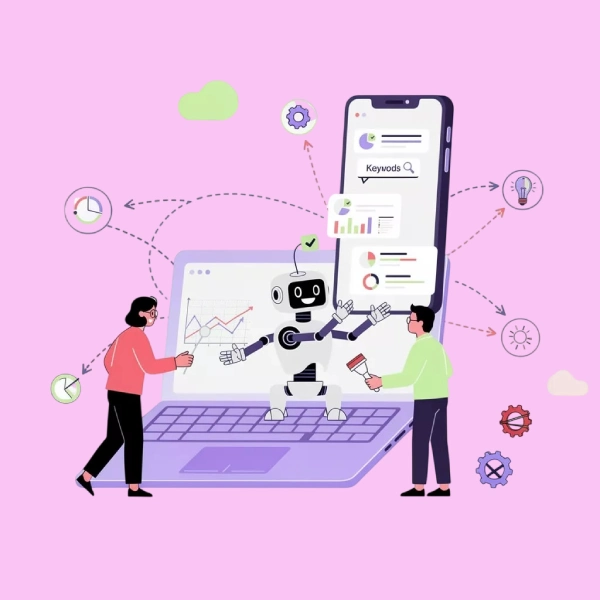
Artificial Intelligence (AI) is revolutionizing the digital marketing landscape, particularly Search Engine Optimization (SEO). By using AI in SEO, businesses can unlock great opportunities to increase their visibility and rankings. This article delves into the tools and techniques reshaping the future of SEO, offering insights for marketers to stay ahead in 2026.
Understanding AI in SEO
In 2026, AI will become an important part of SEO strategies. It will help marketers optimize content and websites efficiently. Artificial Intelligence can be used to automate repetitive tasks, analyze user data, or create SEO-optimized content. Below we have discussed how AI can make your life easier:
- Enhanced Data Analysis: AI can analyze vast amounts of user data in a matter of minutes to identify trends, user behavior, and keyword opportunities.
- Personalized User Experience: With AI, you can create personalized content and campaigns based on individual preferences, increasing your chances of conversion.
- Voice and Visual Search Optimization: As the use of voice assistants increases, you can use Artificial Intelligence to optimize your content and website for voice and image search trends.
With these features, AI-powered SEO tools have become an important part of any successful SEO strategy.
AI-Powered SEO Tools You Need to Know
In order to understand AI in SEO or make yourself future-ready, it is important to use the right tools. Below we have discussed some of the most popular AI-powered SEO tools that you can use to take your SEO strategy to the next level.
1. SEMrush and Ahrefs
SEMrush and Ahrefs are premier keyword research tools that use AI to provide comprehensive keyword analysis and competitor insights. Both of these tools analyze tons of data, helping you understand the required keywords and search intent.
2. Jasper.ai
Jasper is a premier AI content creation tool that you can use to generate SEO-optimized content for your website. Jasper comes with thousands of templates that can help you create quality content for blogs, landing pages, social media posts, and more.
3. Surfer SEO
Surfer SEO is both a keyword research and content creation tool used by SEO executives around the world. Surfer SEO combines real-time data with AI to create content that ranks higher. Furthermore, you can use this tool to get AI keyword recommendations.
4. BrightEdge
One of the best benefits of AI in SEO is predictive analysis, which helps you anticipate future trends. BrightEdge is an AI-powered SEO tool that analyzes a wide range of user data to anticipate future trends. Based on its recommendations, you can optimize your SEO strategy, marketing efforts, and product offerings.
5. ChatGPT
Last but not least in the list of AI-powered SEO tools is ChatGPT. It is an AI assistant that can handle various tasks for you. You can use ChatGPT to analyze data, prepare marketing strategies, or generate high-quality SEO-optimized content. Current models of ChatGPT can also generate images and videos as per the needs of users based on text-based prompts.
These tools not only save time but also ensure more accurate and data-driven decisions for SEO strategies.
Techniques for AI-Driven SEO in 2026
Now that we have understood the advantages of AI in SEO and different tools associated with it, let’s look at how you can use these AI-powered SEO tools for maximum results:
1. Content Optimization
You can use AI to identify the shortcomings in your existing content or create entirely new material that resonates with your audience and brand values.
2. Predictive Analytics
Predictive Analysis is one of the best features offered by AI in digital marketing. You can use AI to analyze vast sets of user data and anticipate search trends, optimizing your marketing strategies accordingly.
3. Voice Search Optimization
With the rise in the use of voice search assistants such as Siri, Alexa, and Google Assistant, it has become important to optimize your content for voice searches. AI can help you optimize your content for conversational queries.
4. Automation of Repetitive Tasks
You can further use AI to automate repetitive tasks so that you can focus on creative and productive work.
5. Real-Time Analytics
With AI tools, you can monitor the performance of your SEO campaigns in real-time and adjust them accordingly to achieve the best results.
Challenges of Using AI in SEO
As we have discussed some of the benefits offered by AI, let’s look at some of the challenges that come with it:
1. Dependence on Data Quality
The performance of an AI tool or model depends on the datasets fed to it. If the data is tainted or biased, then the results produced by the tool will also be biased.
2. Adaptation to Algorithm Changes
While AI is evolving, it is not evolving at the speed at which search engines change their algorithms. As search engines constantly update their algorithms, SEO strategies require adequate adjustments too, but AI models are currently not evolved enough to handle these changes independently.
3. Complexity of Implementation
As Artificial Intelligence is a relatively new concept, integrating it into existing systems can be an exhaustive task. It would require extensive resources and training of personnel to make this integration successful.
In order to gain maximum output from AI-powered SEO tools, these challenges need to be addressed. A balanced approach and skill-building are required to tackle all these issues.
Conclusion
AI is revolutionizing the way we approach SEO, offering innovative tools and techniques that redefine digital marketing. By incorporating AI-powered SEO tools and strategies, businesses can achieve better rankings, enhanced user engagement, and sustainable growth. The key to success lies in understanding the technology’s potential, addressing its challenges, and staying ahead of industry trends.