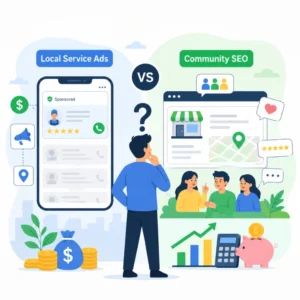
For most local businesses, the honest answer is both, just not in equal parts. Local Service Ads get the phone ringing within days. Community SEO lowers what each lead costs you over the following months and years. The right split between the two depends on how long you have been trying to rank in your area and how many reviews sit on your Google Business Profile today.
This guide walks through what each channel actually costs in 2026, where each one earns its place in the budget, and a split you can use as a starting point instead of guessing.
THE PAID CHANNEL
What Are Local Service Ads?
Local Service Ads (LSA) are Google’s pay-per-lead ad format built for local trades and professional services such as plumbers, electricians, lawyers, and clinics. They sit above both the organic results and standard Google Ads at the top of the search page, and you pay only when a real customer calls or messages you, not per click.
The badge next to your listing changed in October 2025. Google retired the green Google Guaranteed and Google Screened labels and replaced both with a single blue Google Verified checkmark, along with the $2,000 money-back guarantee that used to come with the old badge. The badge now confirms your business passed Google’s checks; it no longer promises a refund.
Because Local Service Ads pull your reviews, hours, and verification status straight from your Google Business Profile, getting that profile in order is the real first step, before a rupee goes into ads. A properly built Google Local Services setup covers what Google actually checks during verification, so leads don’t stall at that stage.
THE ORGANIC CHANNEL
What Is Community SEO?
Community SEO is the organic side of local search: optimising your Google Business Profile, building citations across local directories, publishing content tied to your service area, earning local backlinks, and collecting reviews without paying per click or per lead. You pay for the work, not the outcome, and the outcome keeps paying you back long after the invoice is settled.
If you are starting from zero, our step-by-step local SEO guide walks through the setup in order, and the citation and backlink side of the work is covered in our off-page SEO guide.
THE NUMBERS
The Real Cost Difference in 2026
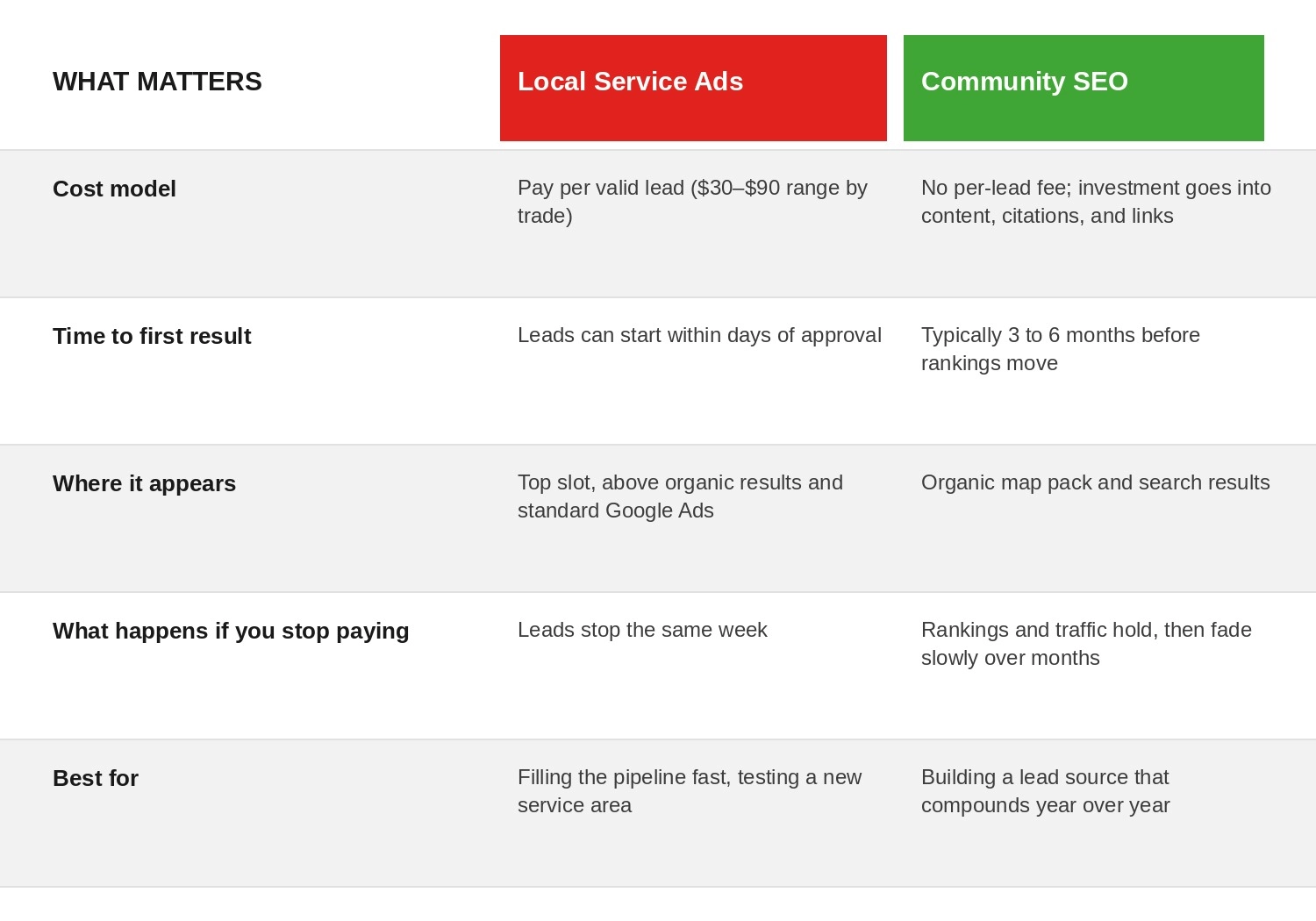
A February 2026 study from SearchLight Digital, built on $6.72 million in tracked Local Service Ads spend across 888 contractors and 126,650 leads, put the blended cost per lead at $53. That figure moves by trade: electrical came in lowest at about $39, HVAC around $51, and plumbing and drain work closer to $57 to $59. A later May 2026 snapshot from Data-Driven Trades put the blended figure higher, at $63.29, which tracks with seasonal demand rather than a change on Google’s side.
For comparison, standard Google Search Ads for the same home service categories averaged a $104 blended cost per lead in the same SearchLight dataset, nearly double the Local Service Ads number. That gap is a large part of why Local Service Ads has become the default paid channel for local trades. Businesses weighing paid channels more broadly can find both formats covered under our Google Ads service.
Community SEO does not carry a per-lead price tag. You pay for the content, citations, and outreach work itself, and the leads that follow do not add extra cost on top. That is the trade-off: Local Service Ads cost is predictable and immediate, community SEO cost is fixed upfront and pays down over time as rankings climb.
TIMING
Speed vs Longevity
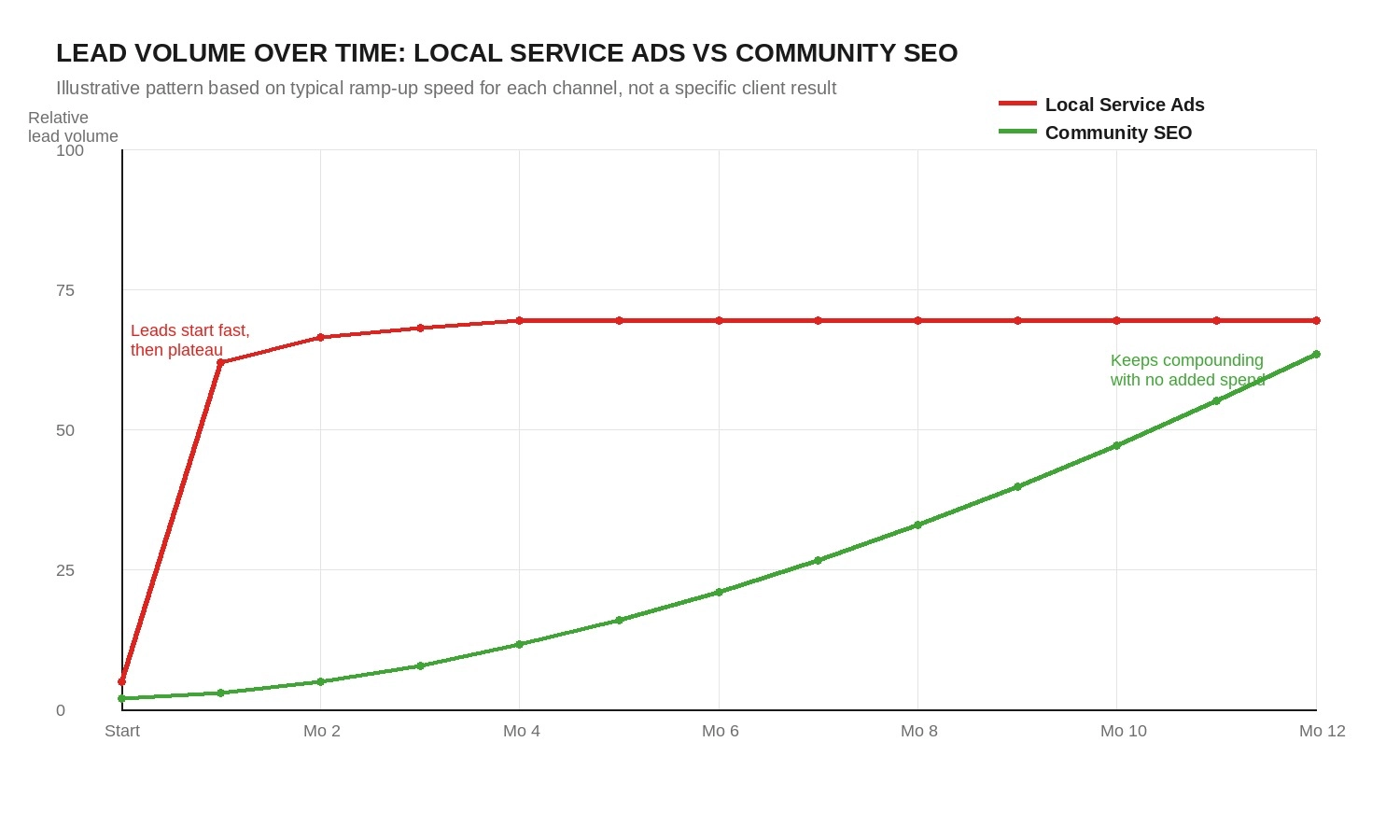
Local Service Ads can start producing leads within days of Google Verified approval, which is the single biggest reason businesses turn to them first. Community SEO usually needs three to six months before rankings move noticeably, since Google needs time to recrawl citations, register new content, and weigh your Google Business Profile against nearby competitors.
The trade happens on the other end. Stop paying for Local Service Ads and the leads stop within the same week. Stop investing in community SEO and rankings hold for months before fading, because links, citations, and published content keep doing their job long after the invoice is paid.
WHERE EACH CHANNEL FITS
Where Local Service Ads Win
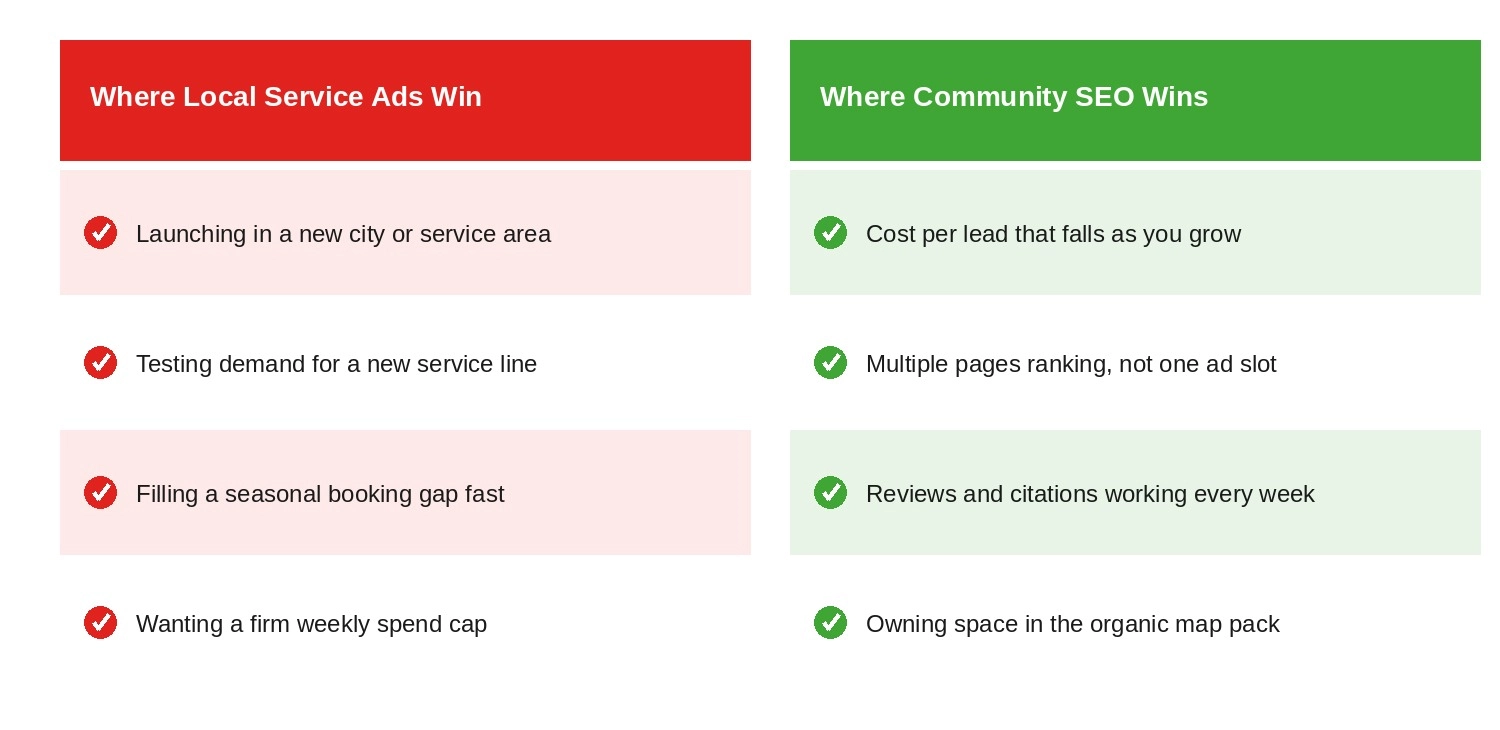
- Launching in a new city or service area with no reviews or ranking history yet
- Testing demand for a new service line before committing budget to content
- Filling a seasonal booking gap quickly, such as before a slow season sets in
- Wanting a firm weekly spend cap with results you can track lead by lead
Where Community SEO Wins
Community SEO wins on math that plays out over a longer period. As your Google Business Profile, location pages, and reviews build up, your cost per lead keeps falling, not because Google charges less, since there is no per-lead charge, but because more of your traffic arrives without any spend attached to it.
- Multiple pages ranking for multiple searches, instead of one ad unit competing for one slot
- Reviews and citations that keep working even during weeks you do not touch the account
- A stronger position in the organic map pack, which sits next to, not inside, the paid Local Service Ads unit
- Social activity and shares that feed back into local rankings, a channel covered in our social media and local SEO blog and handled day to day through social media marketing.
BUDGET PLANNING
How to Split Your Budget by Business Stage
There is no fixed ratio that works for every business, but the stage you are at is a reasonable place to start.
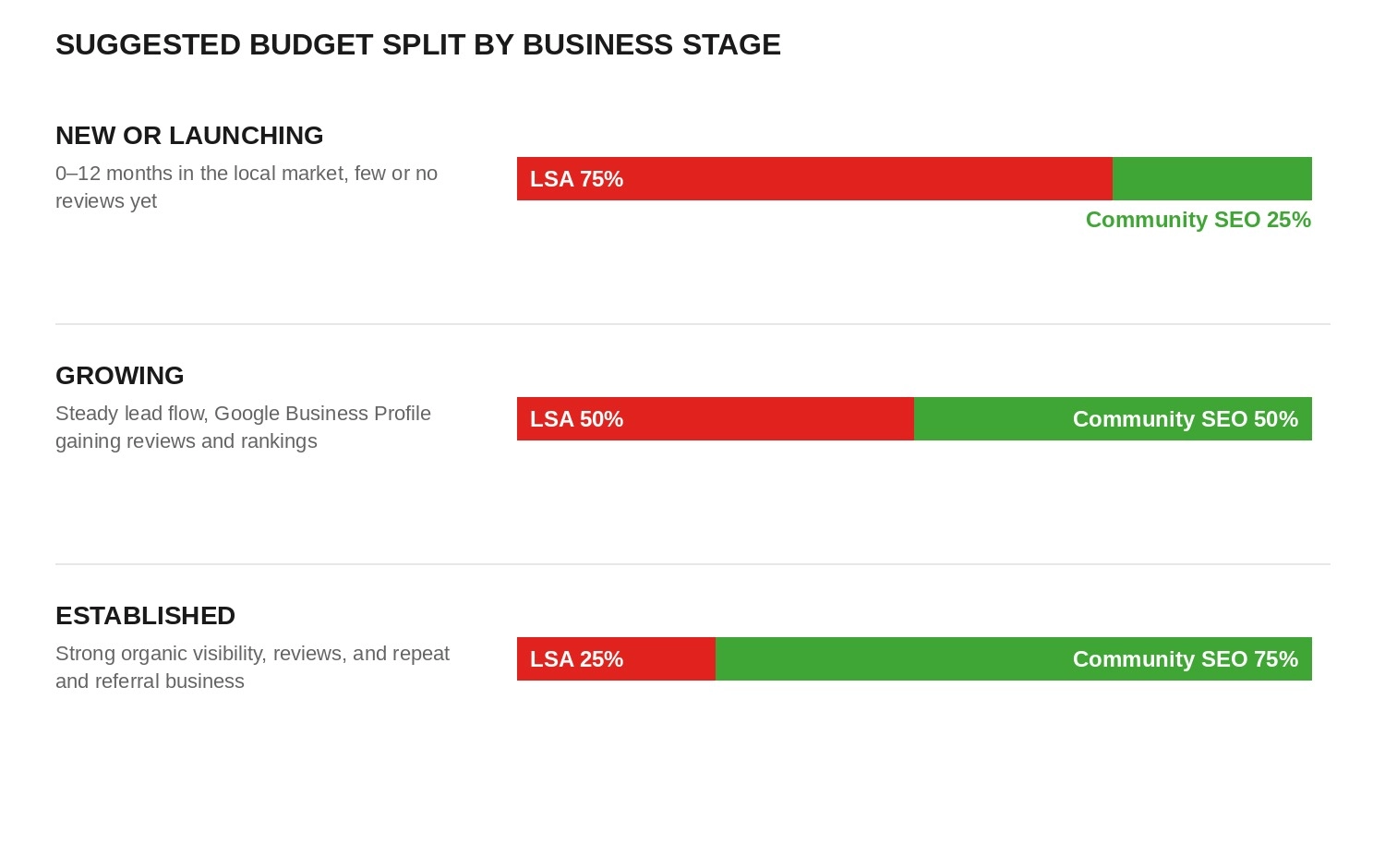
A business in its first year, with few or no reviews, gets more from a heavier Local Service Ads weighting, since organic content has not had time to earn trust yet. A business with steady bookings and a growing profile can afford to split spend evenly while SEO catches up. An established business with strong reviews and repeat customers should flip the ratio, since organic and referral work is already carrying most of the load, and Local Service Ads becomes a smaller, supporting channel rather than the main one.
PITFALLS
Common Mistakes to Avoid
- Treating Local Service Ads as fully automatic. Google’s system reviews lead quality and issues automatic credits within 72 hours for spam or wrong numbers, but every other bad lead needs to be disputed manually.
- Letting the Google Business Profile go stale while running ads, even though both channels pull from it.
- Cutting SEO spend the moment Local Service Ads leads start arriving, which resets the compounding effect described above.
- Comparing Local Service Ads cost per lead directly to a Google Ads cost per click, since the two are priced on different units. Our Google Ads vs. Facebook Ads comparison looks at paid channel costs from a wider angle.
Final Thought
Local Service Ads and community SEO are not competing for the same budget line, even though it might feel that way when both invoices land in the same month. One buys speed. The other builds a growing asset that keeps working after the work itself is finished. Most local businesses need to run both, shifting the weight as reviews, rankings, and repeat customers build up.
Whether that means auditing a Google Business Profile, building out location pages, or setting up Local Service Ads correctly the first time, our SEO services team can help you get the split right for where your business stands today.
Frequently Asked Questions
What is the difference between Local Service Ads and community SEO?
Local Service Ads is a paid, pay-per-lead placement at the top of Google search, while community SEO is unpaid organic visibility built through your Google Business Profile, citations, content, and reviews. Local Service Ads charges you for each lead; community SEO charges you for the work, not the outcome.
How much do Local Service Ads cost in 2026?
Local Service Ads cost roughly $53 per lead on average across home service trades in 2026, based on SearchLight Digital's February report covering $6.72 million in tracked spend. Individual trades range from about $39 for electrical work up to $90 for higher-ticket categories such as roofing, and the number moves with season and market.
How long does community SEO take to show results?
Community SEO typically takes three to six months to show a measurable change in rankings, since citations need to be crawled and content needs time to earn trust. Early wins such as a completed Google Business Profile or a fixed citation can appear sooner, but ranking movement on competitive local terms usually needs a full quarter.
Can I run Local Service Ads and community SEO at the same time?
Yes, and for most businesses that is the stronger approach rather than picking one. Local Service Ads fills the pipeline while community SEO builds up, and once organic rankings mature, budget can move away from paid leads toward the channel that keeps paying for itself.
What happened to the Google Guaranteed badge?
Google retired the Google Guaranteed and Google Screened badges on October 20, 2025, replacing both with a single blue Google Verified checkmark. The $2,000 money-back guarantee that came with the old Google Guaranteed badge was discontinued at the same time, though existing verification status carried over automatically
Which channel gives a better return, Local Service Ads or community SEO?
Neither channel wins outright because they solve different problems: Local Service Ads brings a fast, predictable, per-lead return, while community SEO brings a slower return that keeps improving without added spend. Businesses that run both, weighted to their stage as described above, tend to see the strongest combined return.