Get In Touch
Gurugram
Plot # 1SP, Sector 27, Golf Course Rd, A Block, DLF Phase 1, Sector 27, Gurugram, Haryana 122022, India

Bengaluru
#103, 2nd floor, Unitech Coral Hosa Road, Sarjapur, Bengaluru, Karnataka 560035, India
Work Inquiries
info@creativenexus.in
prabhu@creativenexus.in
rishabh@creativenexus.in
Phone
+91 9999212010
+91 9019321894
+91 98686 57429

SEO vs AEO vs GEO: The Complete 2026 Guide to Winning Visibility Across Google, Voice, and AI Engines

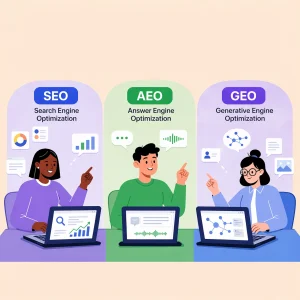
SEO vs AEO vs GEO
Table of Contents

Ranking on Google is no longer the finish line. It is just one of the three places your customers now look for answers.

In a single week last quarter, one of our clients received more brand mentions inside ChatGPT responses than they received clicks from position 3 on Google for the same keywords. The ranking had not dropped. The user behaviour had shifted.

That is the search in 2026. A growing share of queries never reaches a traditional results page. Users are asking ChatGPT, Perplexity, Gemini, and Google AI Overviews, and acting on the answer without clicking. Visibility now lives in three parallel systems: SEO for search engines, AEO for answer engines, and GEO for generative AI. This guide breaks down each one and how our team at Creative Nexus applies them on live client projects.

1. What is SEO?

SEO (Search Engine Optimisation) is the practice of improving a website so that search engines like Google and Bing rank it higher for relevant queries. It remains the foundation of online visibility because every other discovery layer, including AEO and GEO, is built on top of strong SEO fundamentals.

Before an answer engine can quote your page, it has to find your page. Before an AI system can cite your brand, it has to trust your domain. That trust comes from classic SEO signals: quality content, technical health, and earned backlinks.
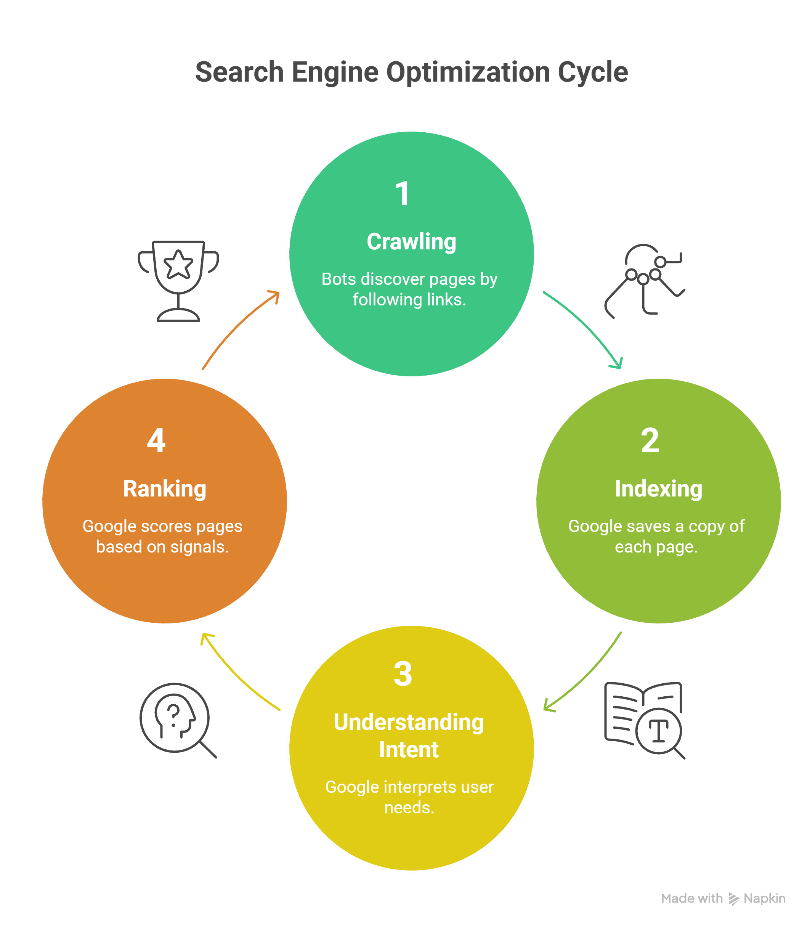
How SEO Works

Crawling. Search engine bots discover your pages by following links across the web.

Indexing. Google saves a copy of each crawled page. If a page is not indexed, it effectively does not exist for search.

Understanding Intent. Google interprets whether the user wants information, a product, a location, or a comparison.

Ranking. Google scores every indexed page across 200+ signals including content depth, page speed, backlinks, and user experience.

2. What is AEO?

AEO (Answer Engine Optimisation) is the practice of structuring content so that search engines, voice assistants, and AI chat tools can extract it as a direct answer. While SEO aims for a ranking, AEO aims for the answer slot itself, delivering visibility without requiring the user to click.

A large portion of Google searches now end without a click, because the user gets what they need directly on the results page. If your content fills that answer slot, thousands of users see your brand without ever visiting your site.
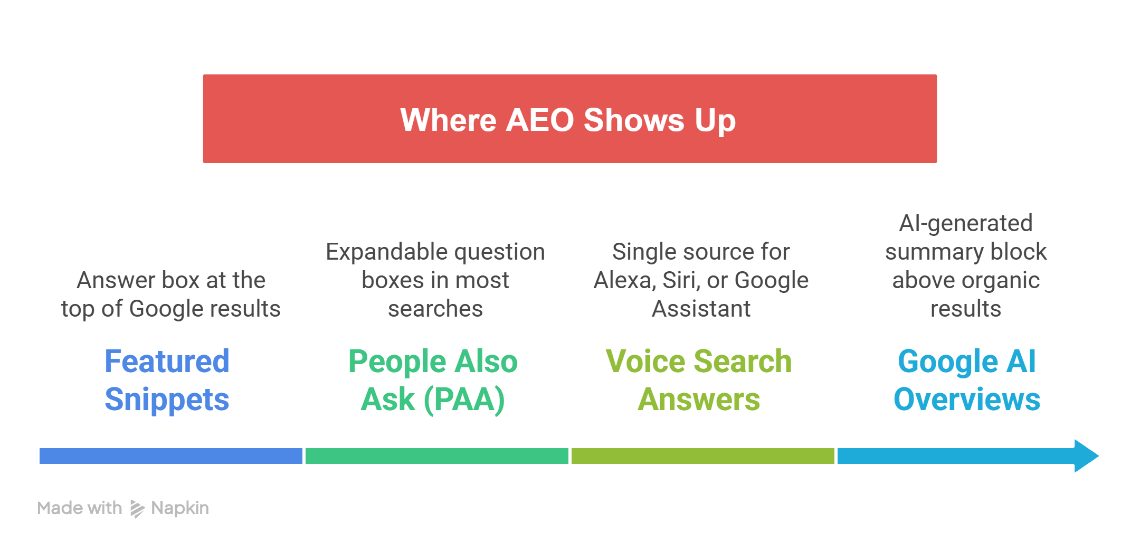
Where AEO Shows Up

Featured Snippets — the answer box at the top of Google results.

People Also Ask (PAA) — expandable question boxes that appear in most searches.

Voice Search Answers — the single source Alexa, Siri, or Google Assistant reads aloud.

Google AI Overviews — the AI-generated summary block that often appears above organic results.

3. What is GEO?
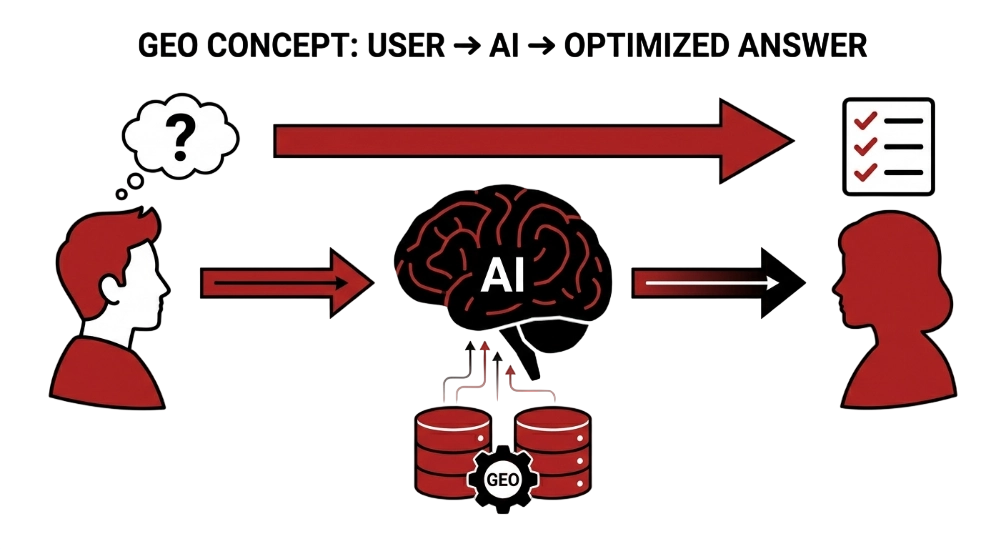
GEO (Generative Engine Optimisation) is the practice of creating content so that generative AI systems like ChatGPT, Perplexity, Gemini, and Claude include your brand in the responses they generate. These systems synthesise information from multiple sources, so your goal is to become one of those trusted sources.

GEO operates on different logic than SEO. Traditional SEO rewards the single best page for a query. GEO rewards content useful enough to be blended into an AI-generated answer alongside other sources. It is less about owning a ranking and more about being part of the conversation an AI is having with the user.

How GEO Works

  • The user asks a conversational question inside ChatGPT, Perplexity, or another AI engine
  • The AI interprets intent — list, recommendation, definition, or comparison
  • The AI pulls from multiple sources via live web retrieval or training data
  • The AI evaluates each source based on authority, clarity, and topical relevance
  • The AI synthesises an answer, often mentioning brands with clear, extractable content
  • The final response reaches the user, sometimes with citations, sometimes without

4. Where Does AIO Fit In?

AIO (AI Optimisation) is an umbrella term covering both AEO and GEO. It refers to the full set of practices that make a brand visible across every AI-powered search surface. Think of AIO as the strategic direction, with AEO and GEO as the specific tactics under it.


5. SEO vs AEO vs GEO: Quick Comparison

Dimension

SEO

AEO

GEO

Primary Goal

Rank on Google and Bing

Be the direct answer

Be cited in AI responses

Key Platforms

Google, Bing

Snippets, PAA, Voice, AI Overviews

ChatGPT, Perplexity, Gemini, Claude

Success Metric

Rankings, clicks, traffic

Snippet ownership, zero-click views

Citation frequency, brand mentions

Content Style

Keyword-led, topical depth

Answer-first, FAQ format

Data-rich, expert-led

Time to Results

3 to 6 months

4 to 8 weeks

2 to 4 months


6. KPIs That Matter in 2026

If you are still judging your SEO team only by keyword rankings, you are missing two thirds of what your brand is doing in search. Track all three:

SEO: organic visibility share, click-through rate, top 3 ranking coverage, conversion quality, and Core Web Vitals health.

AEO: featured snippet ownership, PAA inclusion count, voice answer share, zero-click impressions, and AI Overview capture rate.

GEO: AI citation frequency across ChatGPT and Perplexity, brand mention rate, share of voice inside AI answers, and representation accuracy.

7. How to Optimise for SEO

The SEO playbook is mature. Focus on four pillars:

On-Page

  • Unique title tags (55–60 characters) and meta descriptions (150–160 characters)
  • One H1 per page matching user query, with H2/H3 subheadings for scannability
  • Internal links to related service and city pages woven into body copy

Technical

  • Clean XML sitemap and monitored index coverage in Google Search Console
  • Core Web Vitals passing on mobile for every priority page
  • Schema markup for organisation, breadcrumb, and page type

Content & Authority

  • Genuine topical depth with original data, frameworks, or case studies
  • Topical clusters rather than isolated pages, updated every 6 months
  • Earned backlinks from industry publications and trusted partners

8. How to Optimise for AEO

AEO is where the quickest wins live. Most sites already have content that can be lifted into answer engines, but it is buried under slow build-up paragraphs. Surface the answers and make them machine-readable.

Lead With the Answer

Open every section with a direct, factual statement between 40 and 60 words. Save context and storytelling for after the answer. This single change moves the needle more than any other AEO tactic.

Target Question-Based Keywords

Shift from broad keywords to natural-language questions. Pull them from Google’s “People Also Ask” boxes, AnswerThePublic, AlsoAsked, Reddit threads, and your own customer support queries.

Structure and Schema

  • Use numbered lists for how-to content, bullets for options, tables for comparisons
  • Frame subheadings as the exact question users ask
  • Implement FAQ schema (4+ genuine Q&A pairs), HowTo for tutorials, LocalBusiness for city pages
  • Keep language conversational for voice search, with long-tail phrasing of 5+ words

9. How to Optimise for GEO

GEO is about becoming a source AI systems trust and cite. Depth, originality, and author credibility matter more here than pure keyword optimisation.

Publish Depth and Original Data

AI systems favour content that fully explains a topic: what it is, how it works, why it matters, and where it applies. Add original research, frameworks, specific numbers, and real case studies. Generic rewrites rarely get cited.

Show Expertise and Trust Signals

  • Clear author bylines linked to detailed bio pages with credentials
  • Outbound links to reputable sources supporting factual claims
  • Visible “Last updated” date, active About and Team pages, client reviews
  • Consider adding an llms.txt file to guide how AI engines interpret your content

10. How Creative Nexus Delivers AEO and GEO for Clients

Here is how our team applies these principles on live engagements, based on what we have learned across retail, healthcare, e-commerce, and B2B SaaS projects.

We Start With an Answer Audit

Before touching a page, we list the real questions a client’s customers ask. Then we open ChatGPT, Perplexity, and Google AI Overviews and check what answer these tools return. Nine times out of ten, the client’s website is nowhere in those answers, even when it ranks well on traditional Google. That moment is always a turning point in the conversation — the client suddenly understands why their traffic has plateaued even though rankings look healthy.

We Restructure Before We Rebuild

Most of our early wins come from rewriting, not starting fresh. We rewrite section openings so the answer comes first and context follows. We also push clients to share real numbers — price ranges, delivery timelines, specifications — because AI engines cite the clearest source, not the most generic one.

We Treat Every City as Its Own Market

GEO pushed us to rethink location content entirely. AI engines personalise answers by geography, so a Coimbatore user and a Bangalore user now get different recommendations. We moved every serious client to a city-first architecture — localised positioning, regional case studies, market-specific pricing, and internal links across sibling city pages.

Real Client Outcomes

One B2B client in the NCR region was ranking on page one of Google but invisible in AI Overviews. Over four months we restructured 60 pages, added FAQ and Service schema, and rebuilt their city architecture. By month five, they were appearing as a cited source for 18 priority queries, with noticeably better lead quality.

An e-commerce client operating across 11 Indian cities saw a 180 percent increase in organic traffic from tier-2 markets within six months of implementing our city-first structure, along with consistent ChatGPT citations for location-specific product queries.

11. Mistakes That Silently Kill Visibility

  • Treating SEO as a one-time project instead of an ongoing practice
  • Burying the answer under three paragraphs of introduction
  • Adding FAQ schema to questions nobody actually asks
  • Using vague language like “it depends” instead of giving a direct answer
  • Publishing AI-generated content without original insight or data
  • Skipping author bylines and credibility signals
  • Letting older pages go stale — AI systems deprioritise outdated content
  • Ignoring voice search optimisation for local service businesses

12. The Bottom Line

Search in 2026 is an ecosystem of three overlapping systems. SEO makes you discoverable on Google. AEO makes you the direct answer on snippets, voice, and AI Overviews. GEO makes you citation-worthy inside ChatGPT, Perplexity, Gemini, and Claude.

You do not need to master all three overnight. You need to start thinking in all three directions every time you plan a page or brief a writer. The brands that commit to this shift now will own the visibility the rest of the market is still figuring out how to measure.

Frequently Asked Questions

a) Is SEO still relevant in 2026?

Yes. SEO is the foundation AEO and GEO sit on. A page that cannot be crawled will never get cited by an AI engine either. Run all three together as one strategy.

b) Which should I focus on first — SEO, AEO, or GEO?

If starting fresh, build SEO first. If SEO is solid, prioritise AEO for quicker wins, then layer GEO as a long-term authority play. Most of our clients run all three in parallel once basics are in place.

c) How long does AEO take to show results?

Clients typically see AEO wins within 4 to 8 weeks of an answer-first restructure, especially on sites with decent SEO authority. Voice search and AI Overview citations take closer to 2 to 3 months.

d) Do I need separate content for SEO, AEO, and GEO?

No. One well-structured page can serve all three. Open with a direct answer for AEO, build topical depth and internal links for SEO, and include original data with author credibility for GEO.

e) Which AI platforms should I optimise for?

Current priorities are ChatGPT, Perplexity, Google AI Overviews, Gemini, and Claude. ChatGPT and Perplexity drive the highest referral traffic, while AI Overviews drive the most zero-click brand visibility on Google.

f) How do I measure if my brand is being cited by AI?

Use specialised tools like Profound, Peec AI, or Otterly. You can also run manual checks by asking ChatGPT or Perplexity your priority queries each week. At Creative Nexus, we run monthly citation audits for every active client.

g) Will AI search kill organic traffic?

Organic traffic is changing, not disappearing. What is dying is the assumption that every search leads to a click. What is emerging is brand mentions inside AI answers, which influence purchase decisions long before a user types your URL.

Leave a Reply

Your email address will not be published. Required fields are marked *

We use cookies to give you the best experience. Cookie Policy