
Your best page might never be read by a human again. Someone types a question into ChatGPT. It reads your page, lifts three sentences, drops them into an answer with a small link underneath, and moves on. The person gets what they came for. They never click. Your analytics show nothing. Your sentence did all the work and took none of the credit — and that is the good outcome, because at least the sentence was yours.
That is the game now. Not just ranking a page so a person clicks it. Getting a machine to pull a passage and cite it. They are two different jobs, and the writing that wins the second one looks different from the writing that won the first.
What “on-page AEO” actually means
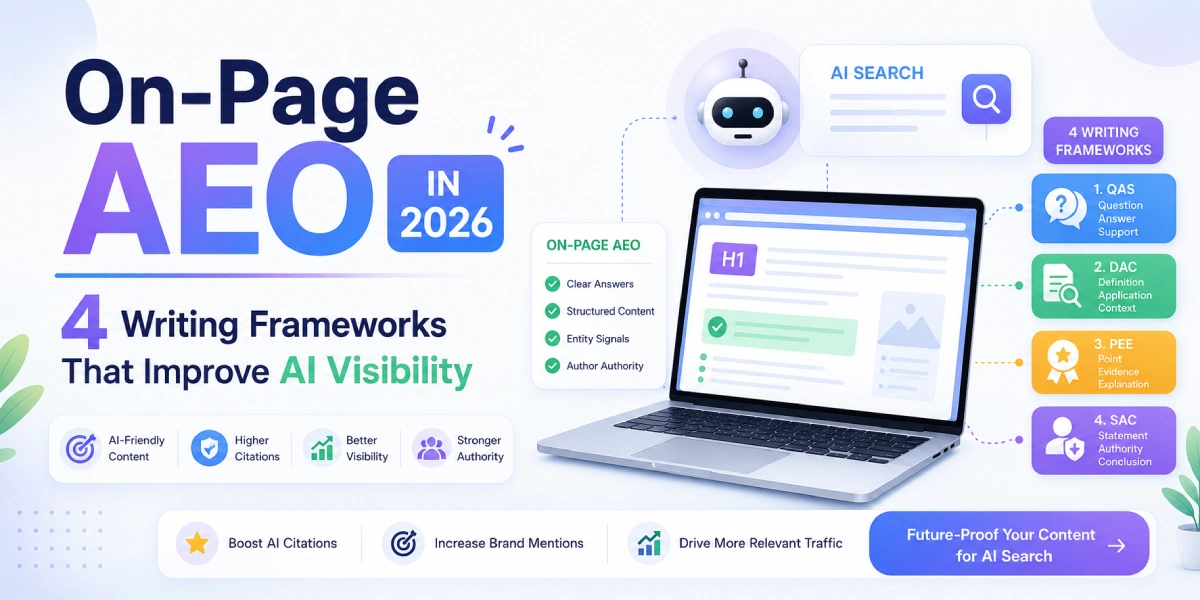
Call it Answer Engine Optimization (AEO) if you want the label. On the page it is not a new discipline bolted onto SEO — it is AI content optimization built on an old instinct: AI-friendly content is just human-friendly content with the fat trimmed off. Better AI visibility rarely comes from a trick. It comes from writing a machine can read fast.
Two quick clarifications before we start. AEO is the page-level half of AI search optimization — the writing and structure that earn AI citations. Generative Engine Optimization (GEO) is the wider game around it: brand mentions, authority, and presence across every engine. This piece is the first half, the part you control sentence by sentence.
The good news: it is mostly just good writing
The good part: you do not need a secret schema or a new vocabulary. You need to write so a machine can read you fast and quote you without flinching.
Four writing habits do most of that work. None of them is new. They were borrowed from military briefings, consulting decks, and newsroom style guides — rooms full of busy people who needed the point in one line. That is exactly what an answer engine wants too. Let us go through all four, with the traps, the examples, and the one thing to steal from each.
First, a reality check nobody wants
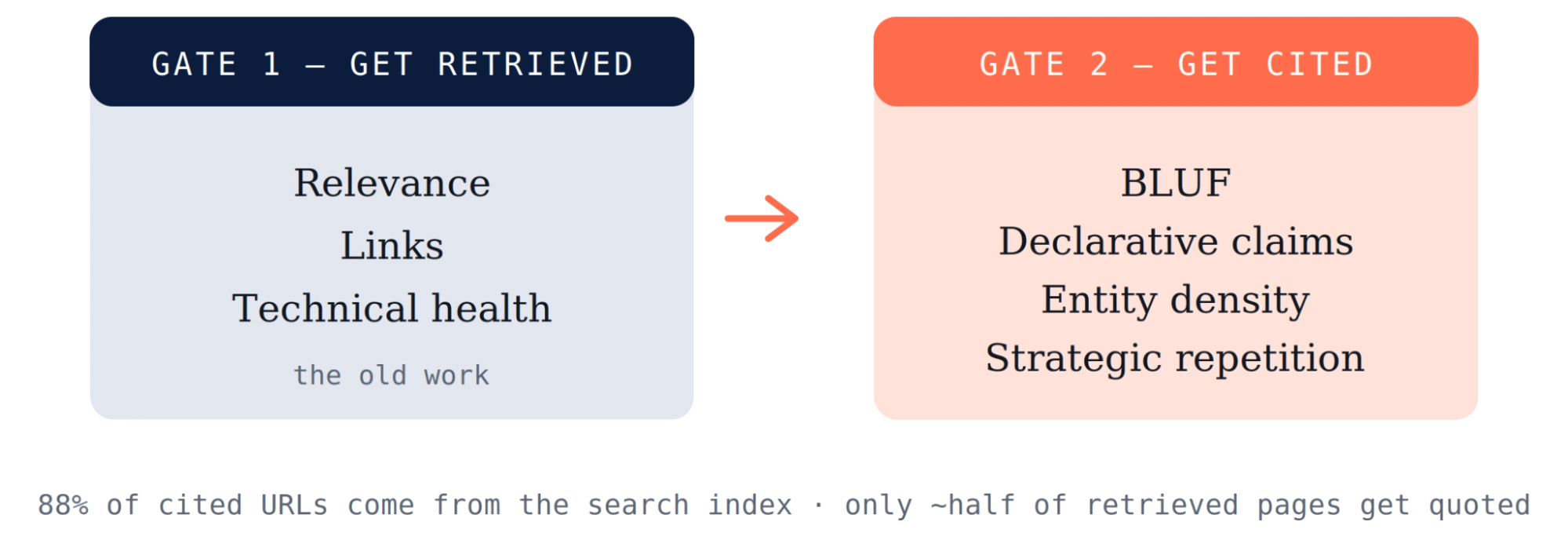
Writing better will not put you in the index. It changes how often you get quoted once you are already there. Ahrefs went through 1.4 million ChatGPT prompts and found that roughly 88% of the URLs it cites come straight from its normal search index. No ranking, no retrieval. No retrieval, no citation. The cleanest sentence ever written cannot be quoted from a page the engine never opened.
So picture two gates. The first gate is getting retrieved — that is your relevance, your links, your technical health, the old work. The second gate is getting cited once you are in the running. The engine usually pulls a handful of pages and quotes maybe half of them. These four frameworks are how you stop being the half it ignores.
1 BLUF: lead with the punchline
WHAT IT IS
BLUF means Bottom Line Up Front. Say the answer in the first sentence or two, then back it up. The military runs on it so a commander can read one line and act. Consultants live by it because the answer goes on slide one and the client is paying by the hour.
WHY THE MACHINE CARES
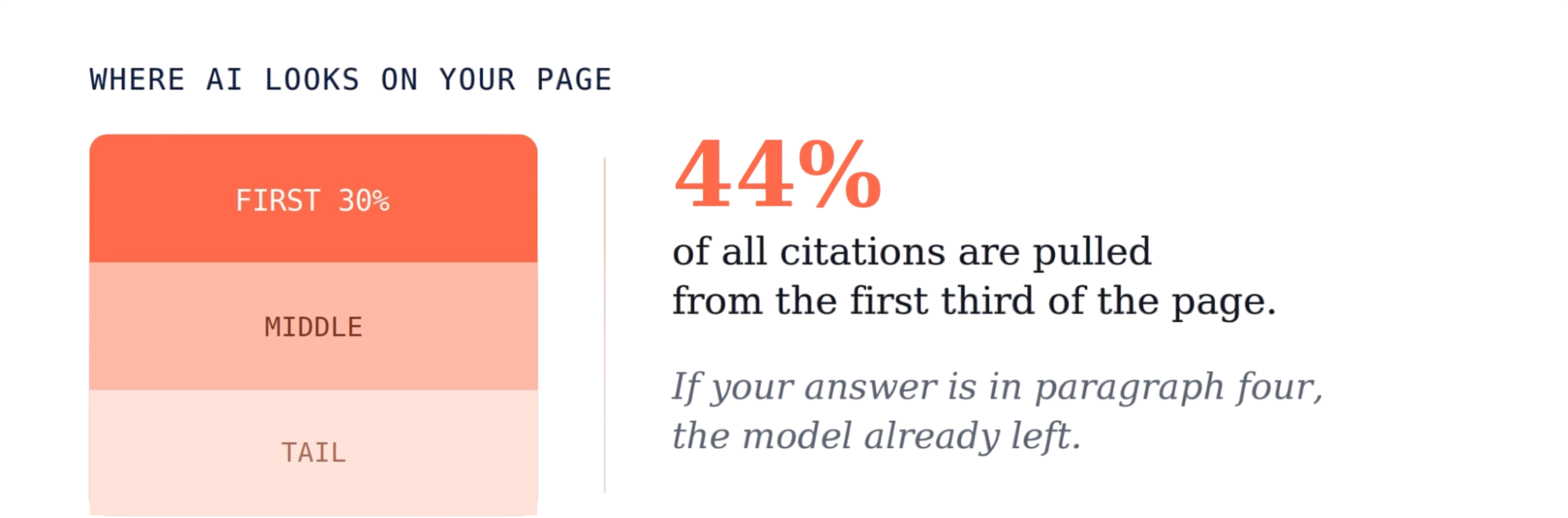
Answer engines read the top of a page, and the top of each section, far more closely than the rest. Kevin Indig’s research put a number on it: about 44% of citations come from the first third of the content. The model reads your opening line, decides whether you answered the question, and bails if you did not. Most writers spend that opening line clearing their throat.
HOW TO DO IT
Open every section with the answer, not a windup. Make the first sentence of each heading stand on its own. Write headings that state the finding, not the topic — “Internal links pass authority to your money pages” pulls its weight; “About internal linking” does not. Then run the skim test: read only the first sentence under each heading. If the whole argument is already clear, you nailed it.
There are many factors behind slow pages — server response, scripts, caching, image weight. After testing, we found image weight is usually the worst offender
Oversized images are the number one cause of slow pages. Server response, scripts, and caching matter, but images cause most of the lag we see in audits.
THE TRAP
Curiosity gaps. Writers love a clever heading that hides the answer to “make you keep reading.” A person might play along. A model will not. It reads the heading, finds no answer, and goes to the page that gave one straight.
STEAL THIS
2 Declarative statements: say it like you mean it
WHAT IT IS
A declarative statement is a claim that stands on its own as an answer. “FAQ schema gives engines clean question-and-answer pairs to quote.” No “it might,” no “in some cases,” no soft landing. Lift the sentence out of the page and it still makes sense.
WHY THE MACHINE CARES
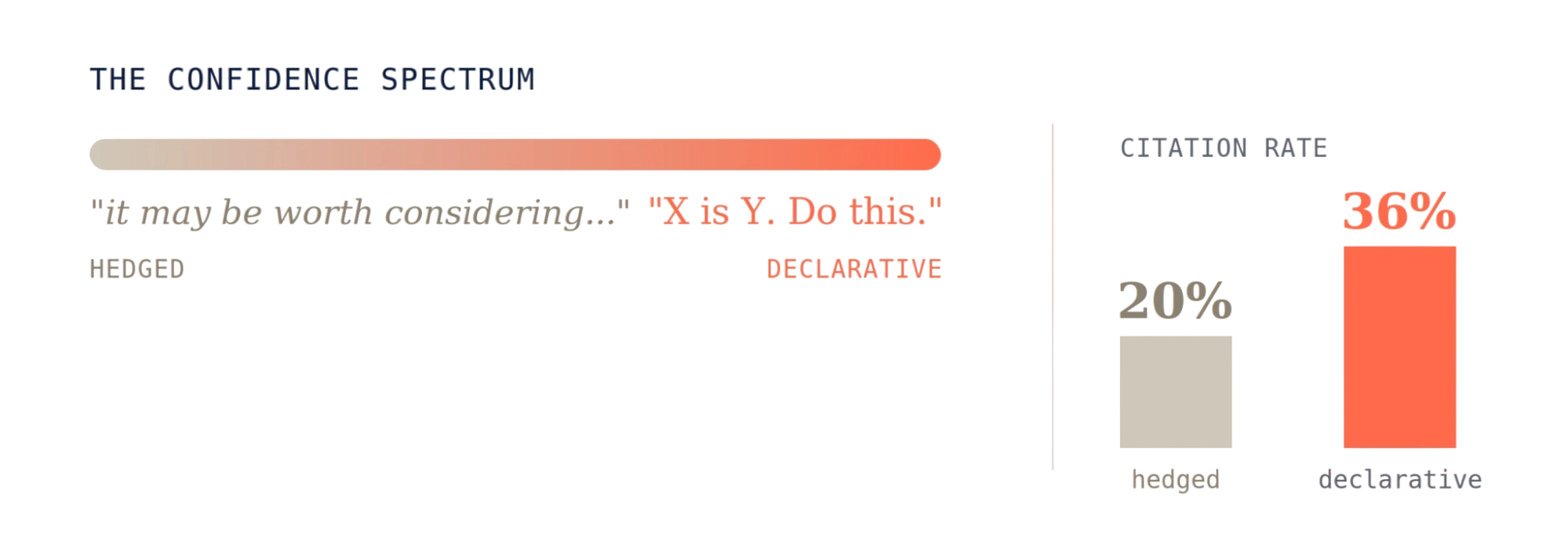
This is the single highest-return change on the list, and it is almost free. Ahrefs found that pages winning citations were nearly twice as likely to use definitive language — “is,” “means,” “refers to” — at around 36% versus 20% for the pages that lost. A model is assembling an answer it has to stand behind. It reaches for the sentence that sounds sure. Hedging reads as doubt, and doubt loses to the competitor who just said the thing.
Related Blog: SEO vs AEO vs GEO The Complete 2026 Guide
HOW TO DO IT
Hunt the qualifiers and cut them: “may,” “might,” “could potentially,” “it is possible that.” Start definitions with “X is” or “X means.” Keep one idea per sentence so it can be lifted whole. And keep honest hedging where it belongs — contested claims, predictions, edge cases. Sounding sure about a fact is good. Sounding sure about a guess is how you lose trust.
It may be worth considering whether adding FAQ schema could possibly help your visibility in AI answers.
Add FAQ schema. It hands answer engines ready-made question-and-answer pairs they can quote directly.
THE TRAP
Old training. If you came up through academic writing, you were taught to qualify everything — it signals care. Online, in front of a model picking who to cite, it signals you are not sure. The fix is a habit, not a talent.
STEAL THIS
3 Specificity: name real things
WHAT IT IS
Entity density is the share of named things in your writing — brands, tools, people, places, metrics, real concepts — against your total word count. High-density writing says Ahrefs, Largest Contentful Paint, Perplexity, 38%. Low-density writing says “a tool,” “a metric,” “some studies,” and hopes you do not notice it said nothing.
WHY THE MACHINE CARES
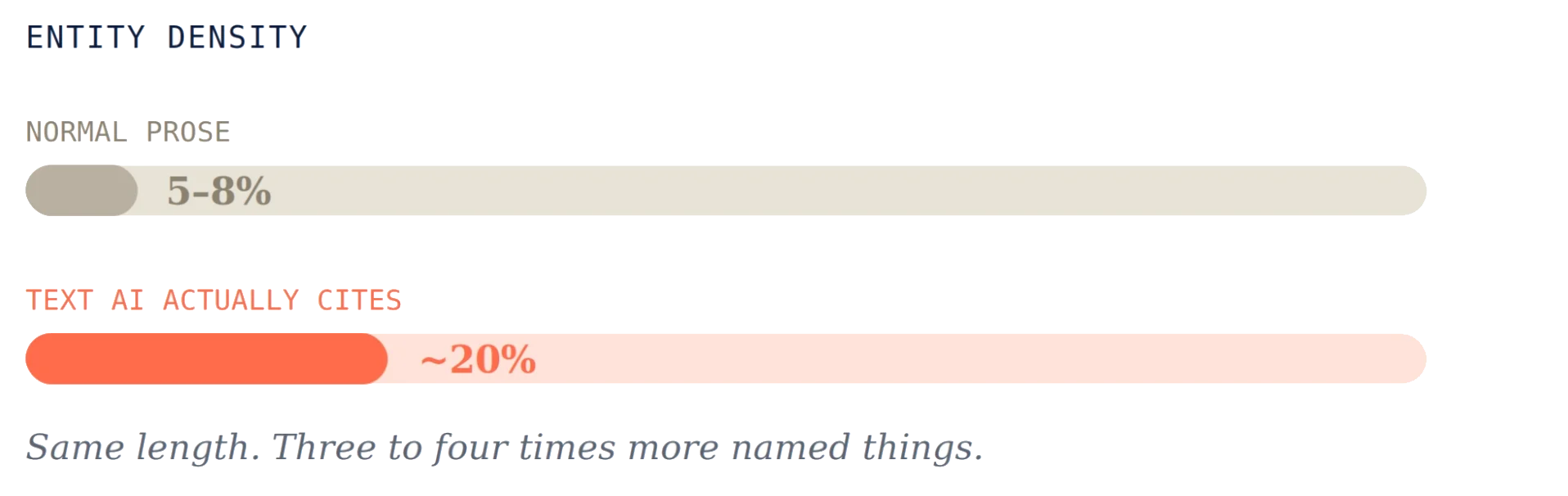
Models think in entities and the links between them — close to how Google’s Knowledge Graph maps the world. The more real things you name, the easier it is for a model to work out what your page is about and whether it fits the question. Ahrefs found heavily cited text runs near 20% entity density, against 5 to 8% in ordinary prose. Three to four times denser. It reads better for people too, because every line carries actual information instead of fog.
HOW TO DO IT
Name the tool, cite the source, state the number. “A popular SEO tool” becomes Ahrefs. “Studies show” becomes the actual study and the figure. “The metric” becomes Largest Contentful Paint. Add real examples, named clients where you are allowed, exact versions, dates. And watch the ratio, not the count — a bloated sentence drowns its own entities. Tighten it.
There are a lot of things you can do to help your site show up better and bring in more visitors over time.
Rewriting title tags, adding 30 internal links, and compressing images cut load time to 1.2 seconds and lifted organic traffic 38% in four months.
THE TRAP
Two of them. One is hiding behind “experts agree” with no expert named. The other is keyword stuffing wearing a costume — entities are real, relevant references, not the same phrase repeated. And the obvious one: specific and wrong is worse than vague. Name real things, get them right.
STEAL THIS
4 Strategic repetition: say it more than once
WHAT IT IS
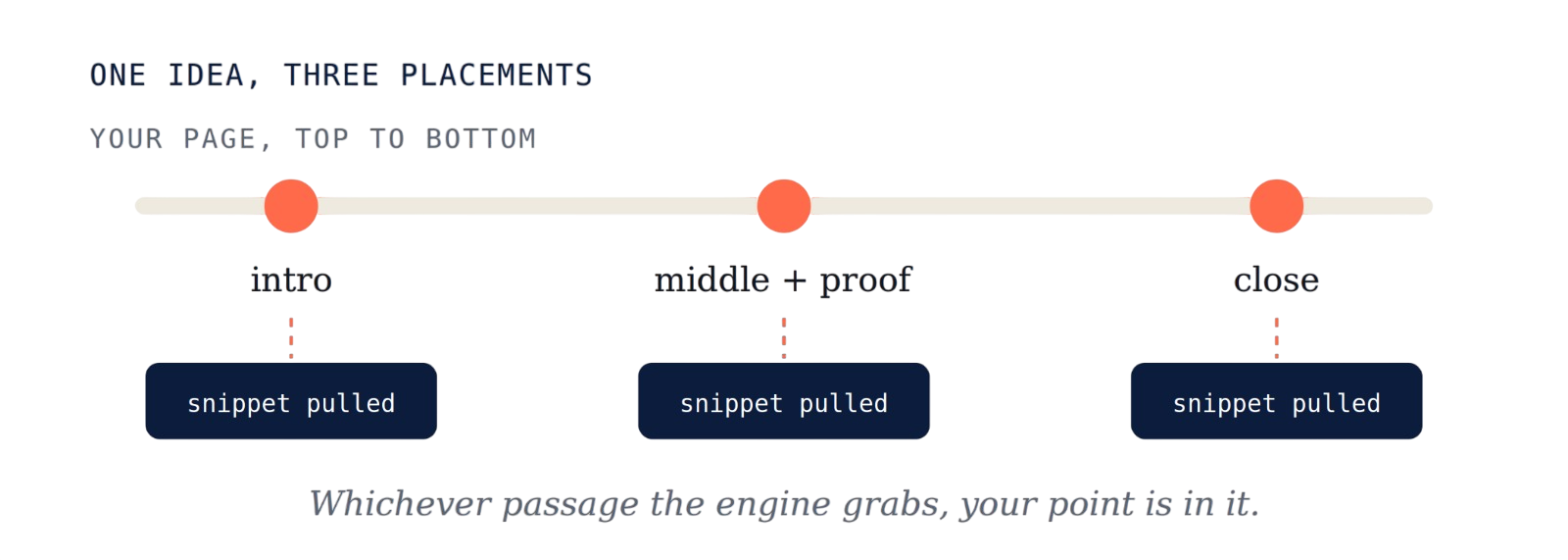
Put your most important idea in several places, reworded each time. Not copy-paste. The same point said three ways — once in the intro, once in the middle tied to proof, once in the close.
WHY THE MACHINE CARES
Engines retrieve short passages, not whole pages. If your key insight sits in one paragraph and the engine grabs a different one, that insight does not exist as far as the answer is concerned. Say it in three spots and you get three shots at landing in whatever snippet gets pulled. Better still: a question gets fanned out into several search variations, so each rewording quietly matches a different one. More phrasings, more matches.
HOW TO DO IT
State the core idea in the intro. Restate it mid-article, anchored to a specific example or number. Land it again in the conclusion as one plain line. Change the wording every time so it reads like a human wrote it and covers more query phrasings on the way.
Updating old posts beats publishing new ones for most established sites.
This is why refreshing existing pages works so well — the traffic gain above came entirely from updates, not new articles.
THE TRAP
Pasting the identical sentence three times. It reads like a glitch and it covers fewer queries, not more. The other miss: repeating some minor point while the main idea only ever shows up once.
STEAL THIS
Now stack all four
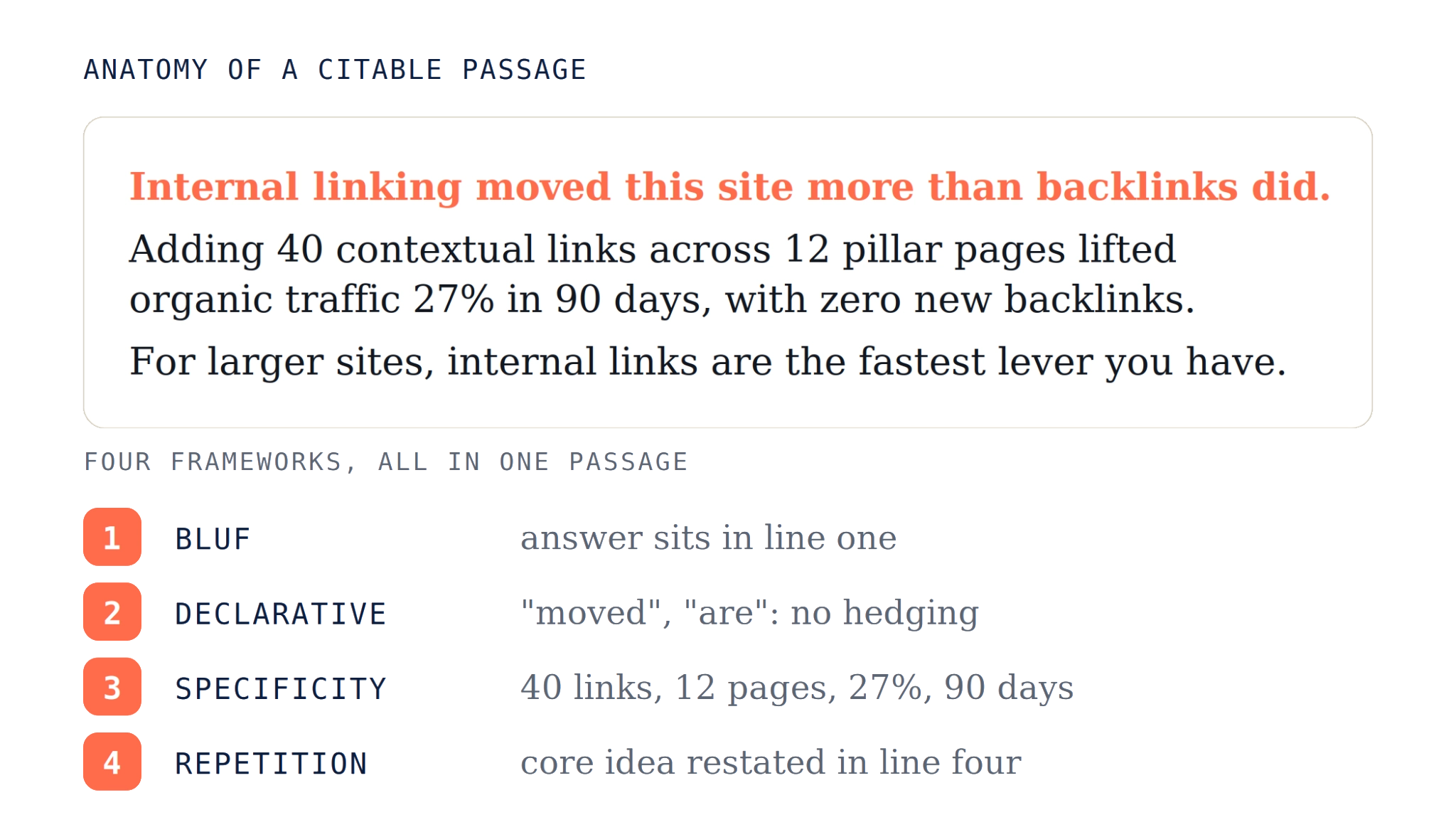
Here is the part most guides skip: these are not four separate chores. The strongest passage you can write does all four at once. It leads with the answer, states it plainly, names real things, and shows up again later in different words. One paragraph, four habits. Get the content structure for AI right and a single passage carries the whole load — that is content optimization for AI search in one habit, not ten.
How to tell if it is working
Track your AI search visibility — two things, really: whether AI engines cite you at all, and which pages earn the AI citations. Ahrefs Brand Radar shows citations across ChatGPT, Perplexity, Google AI Overviews, Gemini, and Claude, plus the exact URLs getting quoted. Watch the trend, not a single day, because citation share shifts every time an engine updates.
Then read it against your normal search data. A page that ranks but never gets cited has a writing problem, and these four are where you start. A page that does not rank at all has a different problem — fix retrieval first, the writing can wait.
Key Takeaways
On-page AEO is not a rewrite of everything you know about content. It is sharper writing: answer first, say it plainly, name real things, repeat what matters. Habits that served readers long before any engine did — and now decide whether a machine quotes you, or the page that sat right next to yours in the results
Frequently Asked Questions
What is Answer Engine Optimization (AEO)?
Answer Engine Optimization (AEO) is writing and structuring content so AI engines and search features can lift a passage and cite it as the direct answer to a question. It targets ChatGPT, Perplexity, Google AI Overviews, and featured snippets, not only blue-link rankings.
What is the difference between AEO and SEO?
SEO works to rank a page so a person clicks it. AEO works to get a passage quoted inside an answer, often with no click. SEO earns the ranking; AEO decides whether you get cited once you rank. You need both.
What is the difference between AEO and GEO?
AEO is the page-level half of AI search optimization — the writing and structure that earn AI citations. Generative Engine Optimization (GEO) is the wider game: brand mentions, authority, and presence across every engine. AEO is what you do on the page; GEO is how the whole brand shows up.
Does AEO replace SEO?
No. AEO sits on top of SEO. Ahrefs found roughly 88% of cited URLs come from the normal search index, so a page that does not rank rarely gets cited. Earn the ranking first, then write for the citation.
What is GEO (Generative Engine Optimization)?
Generative Engine Optimization (GEO) is getting your brand surfaced inside AI-generated answers across engines like ChatGPT, Perplexity, and Google AI Overviews. It covers brand mentions, authority, and cross-engine presence. AEO is the page-level writing inside GEO; GEO is the wider strategy around it.
What content works best for AEO?
Content that answers a clear question wins: how-to guides, definitions, comparisons, and FAQs. Each section should open with a direct answer, carry specific numbers and named examples, and stay easy to skim. Informational, factual content gets cited far more often than vague, promotional copy.
How do I write AI-friendly content?
AI-friendly content is just human-friendly content with the fat trimmed off. Lead with the answer, write in plain declarative sentences, name real entities and numbers, and keep paragraphs short. If a person can skim it and get the point, a model can extract it.
How do I structure content for AI search?
Good content structure for AI uses question-style headings, a short answer right under each one, and one idea per paragraph. Add lists, comparison tables, and FAQ blocks where they fit. Clear structure lets an engine pull a clean passage without guessing what belongs to what.
How long should an AEO answer be?
Keep the lead answer to roughly 40 to 60 words, written as one or two plain sentences directly under the question. That is the chunk most likely to be lifted. Put the detail and context below it for readers and for ranking.
How often should I update content for AI search?
Refresh key pages on a regular cycle, since AI engines weight recent content. Ahrefs found AI-cited pages skew newer than typical search results. Update answers, numbers, and examples whenever they go stale, and re-check whether your pages still get cited after each change.
How do I get my content cited by ChatGPT and other AI engines?
Lead each section with a direct answer, state it as a definitive claim, name real entities and numbers, and repeat your key point in more than one place. Then make sure the page ranks — engines mostly cite pages already in the search index.
What is entity density and why does it matter for AI search?
Entity density is the share of named things — brands, tools, metrics, people — in your writing. Text that gets cited runs near 20% density against 5 to 8% in ordinary prose. More specific references make it easier for a model to match your page to a query.
Does FAQ schema help with AEO?
Yes. FAQPage schema hands answer engines ready-made question-and-answer pairs, so they do not have to guess which text is the question and which is the answer. Pair visible FAQ headings with the schema for the strongest signal.
How do I measure AI visibility and AI citations?
Track your AI search visibility with a tool like Ahrefs Brand Radar, which shows AI citations across ChatGPT, Perplexity, Google AI Overviews, Gemini, and Claude, plus the exact URLs quoted. Watch the trend over time and pair it with Google Search Console for question queries.
What is the BLUF writing framework?
BLUF means Bottom Line Up Front: state your conclusion or answer in the first sentence, then support it. It comes from military and consulting writing. It works for AI because engines weight the top of a section most, with about 44% of citations coming from the first third of a page.
Why does my page rank on Google but not get cited by AI?
Ranking gets you retrieved; writing gets you cited. If a page ranks but never gets quoted, the answer is usually buried, hedged, or too vague to lift. Lead with the answer, state it plainly, add specific numbers, then check again.
Do I need schema markup for AEO?
Schema is not required, but it helps. FAQPage, HowTo, and Article markup tell engines exactly what each block is, so they do not have to infer structure. Pair visible, well-written content with schema; markup alone will not rescue weak writing.
Which AI search engines should I focus on for AEO?
Cover the main ones: ChatGPT, Google AI Overviews, Perplexity, Gemini, and Claude. The writing habits that earn citations are the same across all of them, so you rarely need engine-specific versions. Track which ones actually cite you, then weight your effort there.
How do I get my content into Google AI Overviews?
Rank for the query first, then give a clean, direct answer an Overview can lift. Use a question-style heading, a 40 to 60 word answer under it, specific data, and supporting structure. AI Overviews pull from pages that already rank and answer the query plainly.
Does AEO actually drive traffic or conversions?
AI search sends less raw traffic than Google today, but it tends to convert well because visitors arrive with high intent. Ahrefs reported AI-referred visitors converting at over 10%, well above many channels. Treat AEO as a quality channel, not a volume one, for now.